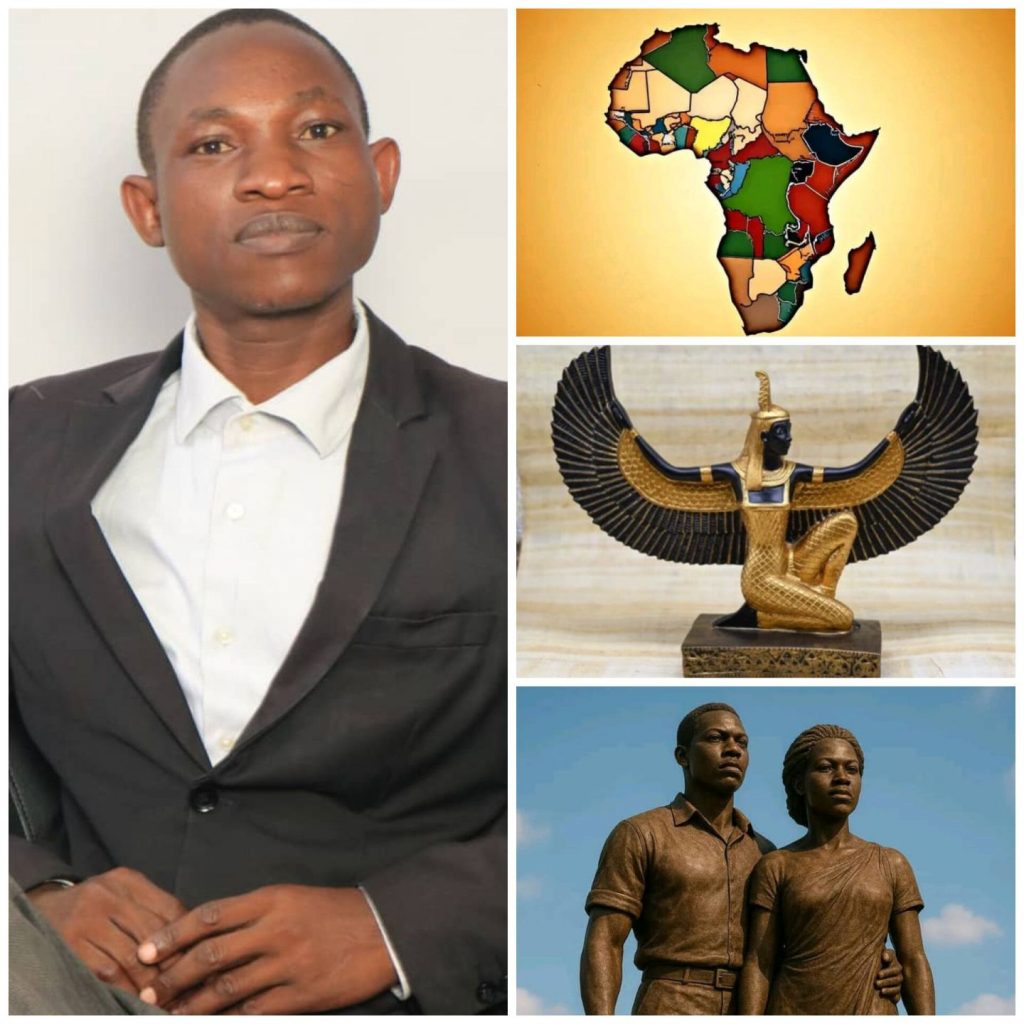
HOW AFRICA, ONCE THE CRADLE OF CIVILIZATION, LOST ITS POWER, VOICE, AND PLACE IN THE WORLD

Power has always been the heartbeat of civilizations. It is the invisible currency that determines who commands, who obeys, who prospers, and who perishes. Power can build nations, create prosperity, and uplift societies. But power can also oppress, enslave, and destroy.
The tragedy of Africa lies not in a lack of resources, creativity, or spirituality, but in the historic loss of power—the erosion of its authority, independence, and global influence. Today, we must ask ourselves: How did Africa, once revered as the cradle of humanity and civilization, lose its commanding place in the world?
The Nature of Power and Its Double-Edged Sword
Power is more than politics. It is the ability to influence ideas, control resources, direct societies, and shape destiny. Throughout history, nations that understood power rose to prominence—whether through knowledge, military might, or economic dominance. But when misused, power becomes oppressive: it exploits the weak, manipulates societies, and transfers wealth from one people to another.
In Africa’s case, power was not only lost; it was stolen, manipulated, and traded away.
The Day the Europeans Landed: The Beginning of Dispossession
Africa’s loss of power can be traced back to the day European ships anchored on its shores. Before then, Africans had already endured sporadic slavery under the Roman Empire, but it was the 15th and 16th centuries that marked the turning point.
According to scholars like Walter Rodney (1981) and Eric Williams (1944), European Christian nations launched the trans-Atlantic slave trade with ruthless efficiency. The Portuguese were among the first to raid the West African coast, hunting the Moors in Mauritania. This violence soon extended across the Gold Coast, as African men and women were hunted like wild game and shipped into bondage.
The question remains: Did Africa resist? The answer is yes. African warriors, armed with spears, arrows, and their indigenous military formations, fiercely resisted these intrusions. The Ashanti of the Gold Coast, for instance, were described as militant and unyielding. But against European firearms and naval superiority, resistance often ended in devastating defeat.
The Firearm Paradox: Trading Humanity for Guns
Faced with the reality of European firepower, African rulers soon faced a tragic dilemma. To protect their kingdoms, they needed guns. But to acquire guns, they had to provide slaves. Thus began a vicious cycle: Africans sold their brothers and sisters into bondage in exchange for weapons that, ironically, were used to capture more slaves.
This paradox entrapped traditional rulers, turning them from independent leaders into unwilling accomplices of European greed. Some condoned the trade willingly; others, under pressure, played into Europe’s hands. Either way, Africa bled.
The Mental Chains: Religion as a Weapon of Domination
Africans knew God long before the Europeans arrived. Our ancestors worshiped the Creator through rivers, trees, the skies, and ancestral traditions. They mediated their spirituality through nature and lived with a deep sense of reverence for the divine.
The Europeans, too, once worshiped in similar ways before technology allowed them to document their beliefs in what became the Bible. But upon arrival in Africa, the Bible was transformed into a weapon—not to save souls, but to enslave minds. Africans were told that their gods were evil, their traditions barbaric, and their salvation lay only in embracing the “European God” and a foreign Messiah.
Religion, which should have liberated, became a tool of mental bondage. As one proverb says: “When the Europeans came to Africa, they had the Bible and we had the land. They told us to close our eyes and pray. When we opened them, they had the land—and we had the Bible.”
The Depths of Exploitation: Slavery and Resource Plunder
Over four centuries, the trans-Atlantic slave trade reduced Africans to commodities. Millions were torn from their homes and shipped across the Atlantic to North and South America, the Caribbean, and beyond. They worked as beasts of burden on sugar plantations, tobacco farms, and cotton fields—fueling Europe’s industrial revolution and enriching American elites.
Africa was not only stripped of its people but of its gold, ivory, and later, its very sovereignty. Colonization institutionalized the exploitation, embedding systems that extracted wealth while leaving Africa impoverished.
Complicity and Resistance: The African Dilemma
It would be intellectually dishonest to portray Africans only as victims and Europeans only as villains. History shows that some traditional rulers actively participated in the slave trade. They sold captives for guns, textiles, and alcohol. They built power on the broken backs of their own people.
Yet, it must also be remembered that resistance was widespread. From the Zulu of Southern Africa to the Ashanti of the Gold Coast, African societies waged wars of survival. They resisted colonization and slavery in countless uprisings, though often overwhelmed by Europe’s superior weapons and coordinated strategies.
Was Africa the Only Victim?
It is important to note that Africa was not alone in suffering under slavery. The Romans enslaved the Britons as early as 100 BC. In fact, Cicero, a Roman philosopher, advised against buying British slaves because they were “stupid and incapable of learning.” History reminds us that slavery was once a universal practice.
But Africa’s tragedy was unique in its scale and duration. While other regions recovered, Africa was drained continuously for centuries—its people, culture, and resources scattered across the globe.
How Africa Lost Power: The Final Analysis
Africa lost power not because it lacked civilization, but because it underestimated the ruthlessness of foreign invaders. Africans lived in organized societies, with structured governance, judicial systems, and spiritual traditions. But trust, hospitality, and internal divisions were exploited.
The Europeans rose by enslaving African labor, plundering African wealth, and controlling African minds. They created global institutions—economic, political, and religious—that maintained their dominance. Africa, once the giver of life, became the world’s exploited periphery.
The Way Forward: Reclaiming Lost Power
The lesson of history is not despair, but awakening. Power can be regained when a people understand their history, unite their strengths, and reclaim their resources. Africa’s future depends on revisiting these truths: that our ancestors were not savages, that our civilizations were advanced, and that our downfall came through manipulation, not inferiority.
Dr. Wakooli concludes: “Africa’s power was stolen through slavery, colonialism, and mental enslavement. To reclaim it, we must rewrite our history, reawaken our dignity, and resist the new forms of exploitation disguised as globalization, aid, and neo-colonialism.”
About the Author
Dr. Omega Mwondha Medi Wakooli is a distinguished historian and public intellectual whose works explore Africa’s history, colonial legacies, and global power dynamics. He is committed to retelling Africa’s story through the lens of truth, justice, and liberation.


Let Africa revise the previous mistakes and put ourselves in fully participation for our progress of development transformation, security integration and social and cultural diversity uplifting