THE OLDEST AFRICAN CREMATION SITE
How humans deal with death and the rituals we build around it are a crucial part of our identity. Burial practices may stretch back hundreds of thousands of years, emerging soon after our ancestors left the trees. Cremation, however, is a different story. Burning the dead requires planning, fuel, and coordinated labor, making it a rare and complex practice in early human history (Sirak et al., 2021).
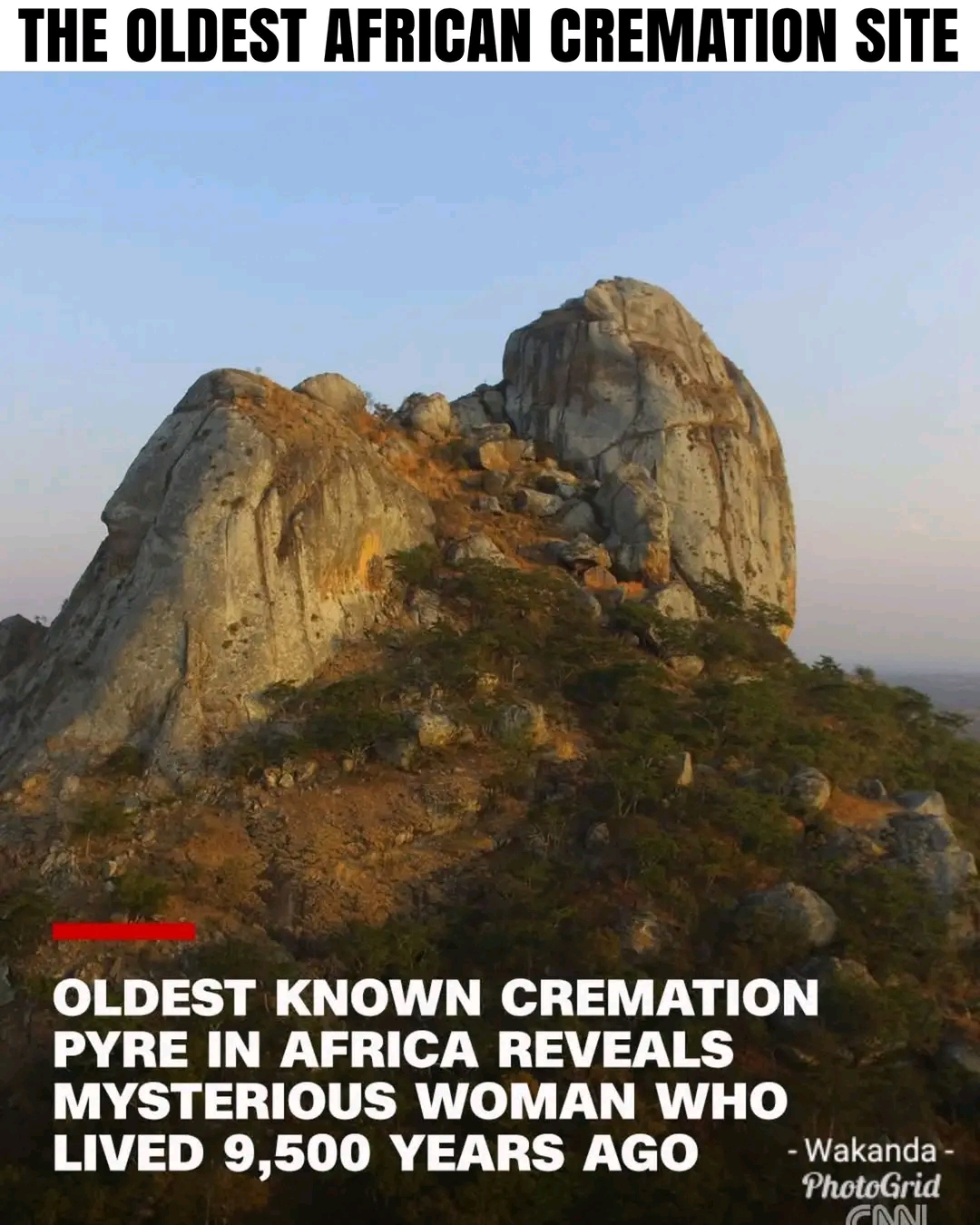
A new discovery from northern Malawi is now reshaping that narrative. Researchers from the U.S., Africa, and Europe have uncovered evidence of a cremation pyre dating back about 9,500 years, the earliest known example of intentional cremation ever found in Africa (Sirak et al., 2021). Published in Science Advances, the study suggests that ancient hunter-gatherers practiced more complex ritual behavior than scientists had previously assumed (Sirak et al., 2021).
The cremation took place at Hora 1, a site at the base of a granite rock rising hundreds of feet above the surrounding plains. Previous research showed people lived there as early as 21,000 years ago and buried their dead between about 16,000 and 8,000 years ago. Taking a closer look revealed something else: ash. Analysis of sediments revealed highly fragmented remains of a single individual (Sirak et al., 2021). No evidence shows that anyone else was cremated there either before or after. The remains belonged to an adult woman between 18 and 60 years old, just under five feet tall. Patterns of heat damage show her body was burned shortly after death, before decomposition began (Sirak et al., 2021).
Cremation itself isn’t new, but intentionally built pyres are rare in the archaeological record. Burned human remains appear as early as 40,000 years ago at Lake Mungo in Australia (Bowler et al., 1970), yet clear evidence of constructed pyres doesn’t emerge until much later. The oldest known in situ pyre dates to about 11,500 years ago in Alaska, containing the remains of a young child (Potter et al., 2011). In Africa, definitive cremations were previously known only from around 3,500 years ago and were associated with Pastoral Neolithic herders rather than hunter-gatherers (Goldstein, 2019; Grillo et al., 2020).
References:
Bowler, J. M., Jones, R., Allen, H., & Thorne, A. G. (1970). Pleistocene human remains from Australia: a living site and human cremation from Lake Mungo, western New South Wales. World Archaeology, 2(1), 39–60.
Goldstein, S. (2019). Rethinking the “Reconfiguring” of the Dead: Secondary Burials and Gesellschaft in the Pastoral Neolithic of Eastern Africa. African Archaeological Review, 36(3), 343–366.
Grillo, K. M., Prendergast, M. E., Contreras, D. A., Fitton, T., Gidna, A. O., Goldstein, S. T., … & Sawchuk, E. A. (2020). Molecular and osteological evidence for a prehistoric double burial from eastern Africa. American Journal of Physical Anthropology, 173(2), 190–206.
Potter, B. A., Irish, J. D., Reuther, J. D., & McKinney, H. J. (2011). A terminal infant burial at Upward Sun River, central Alaska. American Antiquity, 76(3), 526–537.
Sirak, K. A., Miller, J. M., Sawchuk, E. A., Adams, S. M., Llamas, B., Olalde, I., … & Ponce, P. (2021). A case of careful cremation from the early Holocene of Malawi. Science Advances, 7(51), eabj8917.