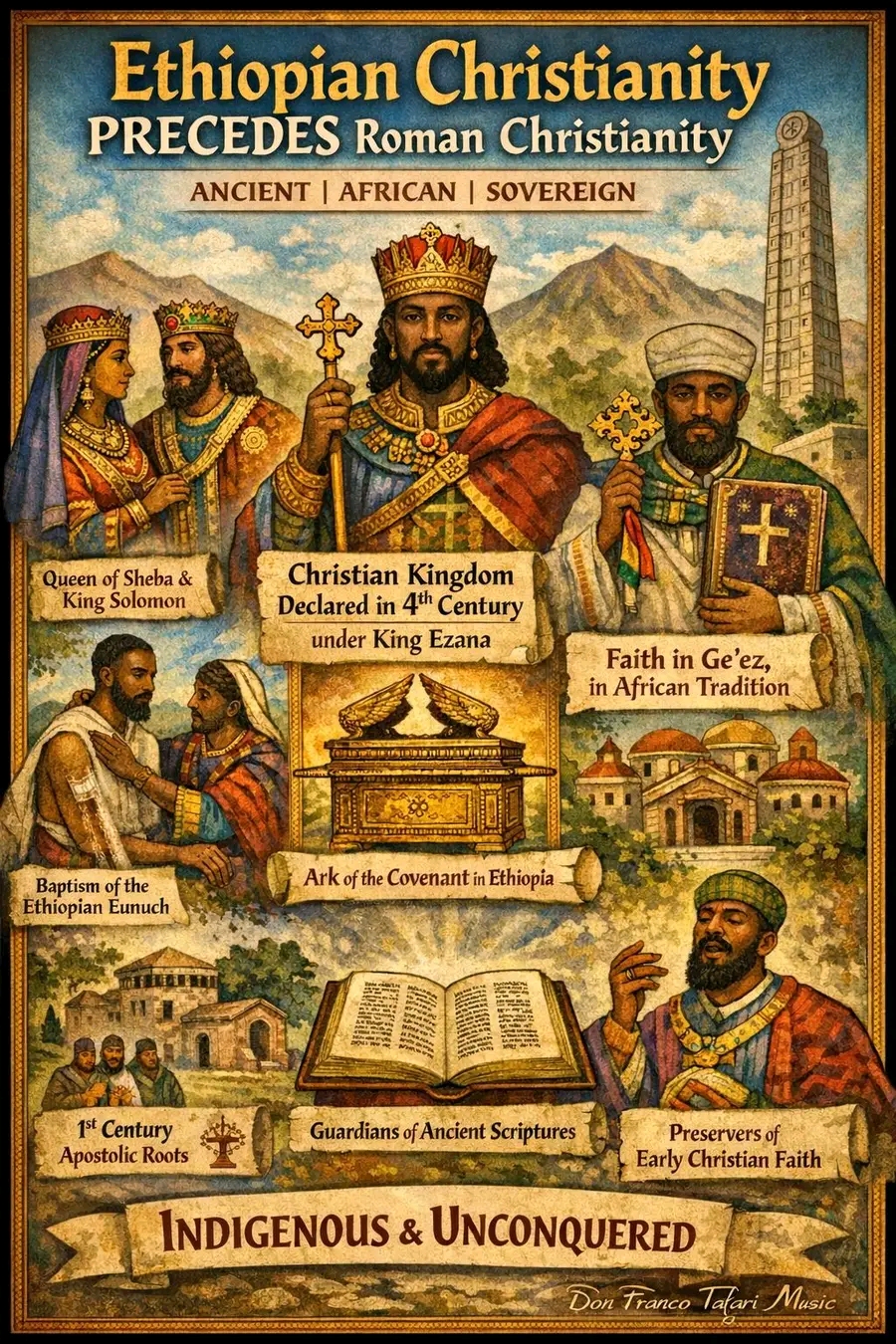
Ethiopian Christianity did not come through foreign invasion, colonization, or forced conversion. Unlike much of the Christian world, Ethiopia embraced Christianity through peaceful spiritual transmission, trade, royal adoption, and ancient biblical connections that predate Roman Christianity as a state religion.
1. Biblical Roots Before Rome
Ethiopia’s relationship with the God of Israel existed centuries before Christ and long before Christianity became institutionalized in Rome.
The Bible repeatedly mentions Ethiopia (Cush) as a land known to God (Psalm 68:31: “Ethiopia shall soon stretch out her hands unto God”).
The Queen of Sheba (Makeda) and her meeting with King Solomon (1 Kings 10) established a Judeo-Ethiopian covenant.
According to Ethiopian tradition, their son Menelik I brought the Ark of the Covenant to Ethiopia, making the land deeply rooted in Old Testament worship long before Europe encountered Christianity.
This means Ethiopia was already monotheistic and spiritually aligned with biblical faith prior to the rise of Roman Christianity.
2. Christianity Arrives in the 1st Century
Christianity reached Ethiopia extremely early—within the lifetime of the Apostles.
Acts 8 records the baptism of the Ethiopian Eunuch, a royal official of Queen Candace, by Philip the Evangelist.
This makes Ethiopia one of the first nations outside Israel to receive the Gospel.
The Eunuch did not convert as a conquered subject, but as a royal official, carrying Christianity back into Ethiopian court life.
3. State Adoption Before Rome
Ethiopia officially declared Christianity as a state religion in the 4th century, under King Ezana of the Aksumite Empire (around 330–340 AD).
This occurred before or at the same time as Rome’s Christianization under Constantine. @mayfo Africa
Crucially, Ethiopia adopted Christianity independently, not through Roman authority.
Ethiopian coins from Ezana’s reign already bore the cross, showing state endorsement.
Thus, Ethiopian Christianity is not a Roman offshoot—it developed alongside early Christianity, not under imperial domination.
4. An African Christianity, Not a European One
Ethiopian Christianity grew in Ge’ez language, African liturgy, and African theology.
Scriptures were translated into Ge’ez, one of the world’s oldest written languages.
Ethiopian Christianity preserved ancient practices that were later altered or abandoned in Europe, including:
Observance of Saturday Sabbath
Old Testament dietary laws
Deep integration of biblical history with African culture
The Ethiopian Orthodox Tewahedo Church maintained its own theological identity, emphasizing the unity (Tewahedo) of Christ.
5. Never Colonized, Never Converted by Force
Ethiopia stands unique in Africa as a nation that:
Was never colonized
Never had Christianity imposed by missionaries or imperial powers
Preserved its church through centuries of Islamic expansion and European colonial pressure
Its faith survived because it was indigenous, not imported.
6. Preserver of Ancient Christianity
While much of the early Christian world changed through councils, schisms, and empire politics, Ethiopia preserved:
One of the oldest biblical canons (81 books)
Ancient liturgical music attributed to Saint Yared
Continuous monastic traditions older than many European churches
Ethiopia became a guardian of early Christianity, not a late recipient.
Conclusion
Ethiopian Christianity is ancient, African, and sovereign. It did not arrive through invasion, colonization, or Roman decree. It grew from biblical foundations, royal adoption, and uninterrupted tradition that predates and parallels Roman Christianity.
Ethiopia is not a branch of Christian history—it is one of its roots. @highlight
@Dr.omega mwondha