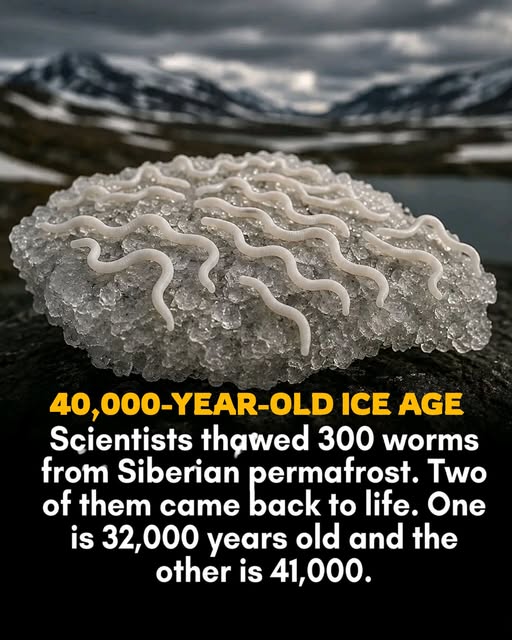
Scientists studying the ancient permafrost of Siberia made a discovery that sounds almost impossible: they recovered hundreds of prehistoric nematodes that had been frozen for thousands of years.
Among them, two worms were successfully revived.
Researchers estimated that one had been frozen for about 32,000 years, while the other was approximately 41,700 years old.
After remaining trapped in the frozen ground for tens of thousands of years, the worms were thawed under laboratory conditions. Remarkably, they began moving and feeding again.
The discovery was significant because it showed that some microscopic animals can survive extremely long periods in a frozen, dormant state—a process known as cryptobiosis.
It also raised fascinating questions about how life can endure Earth’s most extreme conditions and whether ancient organisms may preserve biological mechanisms that scientists are only beginning to understand.
Imagine being frozen for more than 40,000 years—and then waking up and eating again.
For these tiny worms, the past was not the end. It was simply a very long sleep.