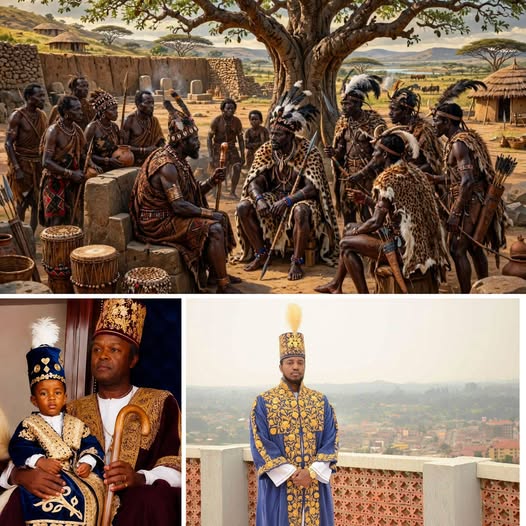
If you are a Mutooro or a Munyoro, there is a fascinating question buried in the history of your kingdom:
Why do so many of our kings carry names that appear to have Luo origins?
Oyo. Rukidi. Olimi. Winyi. Kaboyo. Duhaga.
These are not simply names chosen at random. According to Bunyoro-Kitara oral traditions, they carry the memory of a time when the old order of the Bachwezi was coming to an end and a new royal dynasty—the Babiito—was about to rise.
The story begins long before the modern kingdoms of Bunyoro and Tooro.
WHEN THE BACHWEZI RULED KITARA
Long ago, the great Kitara Empire was associated with the Bachwezi, a powerful and semi-sacred ruling dynasty whose influence stretched across much of the Great Lakes region.
Their political and spiritual centre was associated with Bigo bya Mugenyi, and their kingdom was remembered as prosperous and powerful.
But according to tradition, the reign of the Bachwezi eventually began to collapse under a series of strange and terrifying signs.
King Wamara, one of the last great Chwezi rulers, began receiving reports that something was terribly wrong.
His cattle, the foundation of royal wealth, were behaving strangely. Cows were said to be producing blood instead of milk. Then came an even more disturbing event: Bihogo, the sacred cow of Mugenyi, died at a salt lick.
At the same time, rebellions began breaking out.
The kingdom was no longer at peace.
Wamara summoned his diviners to discover what the signs meant.
They prepared a fattened calf for divination. Its mouth was rinsed with milk, and the animal was slaughtered according to the ritual.
Then they opened it.
What they found terrified them.
There were no entrails inside the animal.
Nobody could explain the mystery.
Until a stranger arrived.
THE LUO DIVINER NYAKOKA
His name was Nyakoka, described in the tradition as a Luo diviner who had come from across the Nile.
Nyakoka examined the carcass. He struck the head and the legs of the calf—and, according to the story, the missing entrails suddenly fell out.
They were covered with black soot from the fire.
Nyakoka then interpreted the signs.
His message was devastating.
The empty stomach, he explained, meant that the reign of the Bachwezi was coming to an end.
The fact that the entrails appeared in the head and legs meant that the Bachwezi would no longer rule as ordinary kings. They would survive in another form—as spiritual beings associated with Mbandwa shrines and traditional religious practices.
But the black soot carried an even darker warning.
Kitara would be taken by strangers from another land.
The Bachwezi were furious.
According to the oral tradition, they tried to kill Nyakoka.
He escaped.
He crossed the Nile and returned northwards, towards Bukidi, a region traditionally associated with the Luo-speaking peoples of what is today northern Uganda, particularly areas connected with Lango and Acholi traditions.
But Nyakoka was not returning to an ordinary village.
He was going back to a people connected, according to the tradition, to the future royal house of Bunyoro.
THE CHILD OF TWO WORLDS
Generations earlier, a Chwezi prince called Isimbwa had travelled into Luo territory while hunting.
There, he left behind a son.
That son was Kyomya.
Kyomya eventually married a Lango woman named Nyatworo, traditionally remembered as a daughter of Labongo of the Mukwonga clan.
Their union produced a child whose identity stood between two worlds.
He was remembered as Isingoma Mpuga Rukidi.
The names themselves became part of the story.
Isingoma was interpreted in Bantu tradition as connected with the father of the drums or a royal title given by his subjects.
Mpuga, associated with empuuga, referred to the black-and-white cow and came to symbolize his mixed ancestry.
And Rukidi was associated with his place of birth.
The young Rukidi and his brothers grew up as hunters and became respected among the Luo communities.
Then Nyakoka found him.
The tradition says that Rukidi was resting beneath a Bito tree when the diviner approached him.
Nyakoka told him that the old kingdom had lost its ruler.
“Kitara has no king. Go and take it.”
Those words changed the history of the region.
THE JOURNEY BACK TO KITARA
Rukidi gathered a small group of followers and began the journey southwards.
They crossed the Nile and entered the territory of the former Chwezi kingdom.
Some versions of the oral tradition preserve a darker detail: that a child had to be sacrificed before the group could successfully cross the river.
Whether understood literally, symbolically, or as part of a later oral tradition, the episode emphasizes how dangerous and extraordinary the journey was believed to have been.
When Rukidi and his followers finally reached the old Chwezi centre, they were strangers.
The people of the region saw before them a new royal claimant who did not look or speak exactly like them.
He carried both identities.
He was connected to the old Chwezi line through his ancestry, but he had also grown up among Luo-speaking people.
He was, in the language of the tradition, a man between two worlds.
Rukidi approached two of Wamara’s wives, Bunono and Iremera, and asked the question that mattered most:
“Where did the Bachwezi go?”
Their answer was simple:
They had disappeared towards Lake Victoria.
They would not return.
Rukidi then took possession of the royal drum.
And with that act, according to Bunyoro oral tradition, a new dynasty began.
THE BABIITO RISE
The old Chwezi order had ended.
The Babiito had arrived.
The kingdom that emerged would eventually be remembered as Bunyoro-Kitara.
But something remarkable happened.
The new rulers gradually adopted the language and culture of the people they ruled.
The royal court became firmly rooted in the Bantu-speaking world, and Runyoro became the language of the kingdom.
Yet the memory of the rulers’ northern ancestry did not completely disappear.
It survived in something much harder to erase:
royal names.
The throne names associated with the early Babiito rulers included:
Rukidi. Ocaki. Oyo Nyimba. Winyi. Olimi. Chwa. Nyabongo.
These names became part of the royal vocabulary of Bunyoro.
And that is where the mystery of Oyo begins.
WHY DID THE KINGS KEEP LUO NAMES?
The argument preserved in this tradition is not that the Banyoro themselves became Luo.
They did not.
The people of Bunyoro and Tooro developed as Bantu-speaking societies, with their own language, culture, institutions and identity.
Rather, the tradition says that the royal dynasty carried an older northern connection.
The kings became Bantu-speaking rulers, but their royal lineage preserved names associated with their ancestral history.
This may also explain the importance of royal naming.
When a prince became Omukama, he could take a throne name associated with an ancestor.
The name was more than an ordinary personal name.
It connected the new king to the royal lineage that came before him.
In this way, a name such as Rukidi or Olimi became a bridge between generations.
THE BIRTH OF TOORO
Centuries later, the same royal tradition would produce another kingdom.