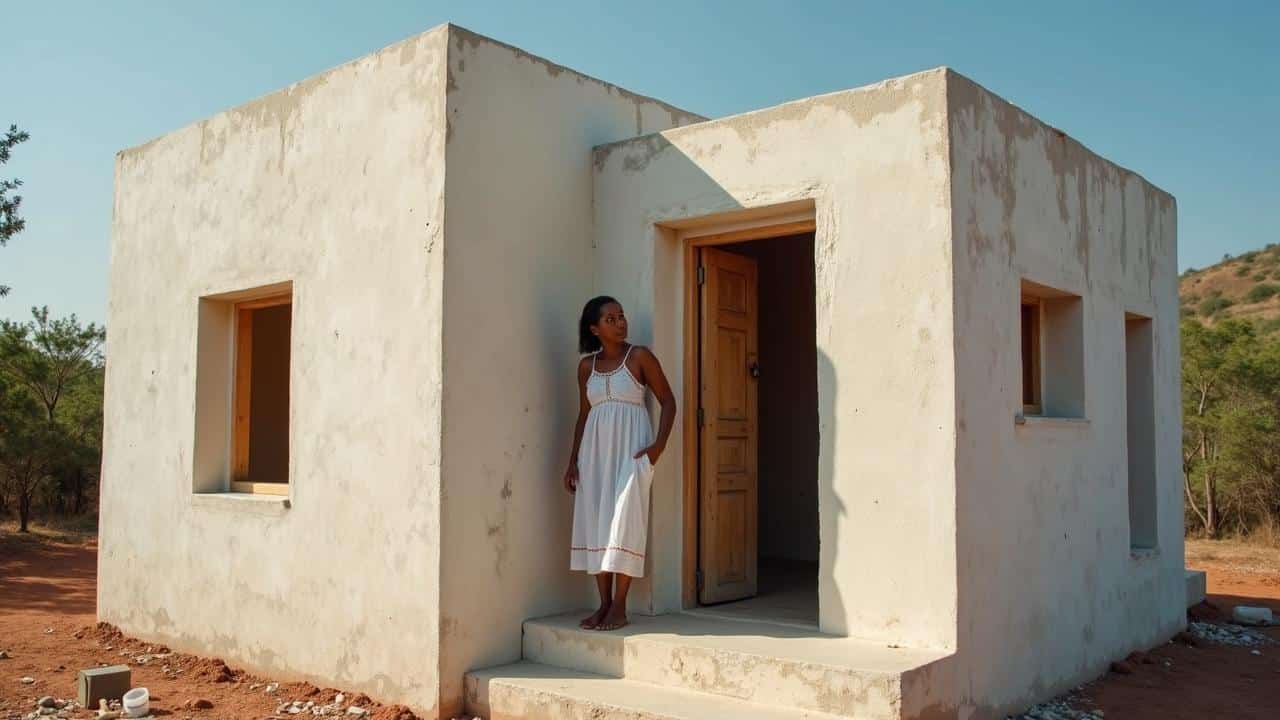
On a quiet plot of land, without cranes, cement mixers or a team of builders, a woman decided to build her own home using an unusual material: polystyrene foam blocks.
There was no heavy machinery. No concrete walls rising slowly over weeks. Instead, there were lightweight white blocks, a hot wire cutter, steel reinforcement bars and determination.
At first, neighbors were skeptical. A house made of foam sounded fragile — almost temporary. Some expected the first storm to destroy it. But months later, the house still stands firm.
A Different Way to Build
The woman, a teacher by profession, could not afford the high cost of traditional construction. Bank loans were uncertain, and contractors’ estimates were far beyond her budget. Instead of waiting years to save for bricks and concrete, she chose a faster, lighter and more affordable method.
She ordered expanded polystyrene (EPS) blocks from a local supplier. The blocks were so light that two people could carry them easily. Unlike concrete, they required no deep foundations or heavy equipment.
The construction followed a simple principle:
light core, strong outer shell.
The foam blocks were stacked like large Lego pieces. Steel reinforcement bars were inserted vertically and horizontally at key structural points. In some areas, thin layers of micro-concrete were added for extra strength.
Once the structure was complete, the walls were covered with reinforced plaster and fiberglass mesh. This created a hard outer skin that protects the foam from rain, sun and humidity.
From the outside, the finished house looks like any small modern home. Only when you tap the wall do you notice the difference — a lighter, hollow sound instead of solid concrete.
Tested by Rain and Heat
Shortly after construction began, a heavy storm hit the area. Many believed the foam walls would absorb water or collapse. They didn’t.
Because EPS foam is made of closed cells, it does not soak up water like a sponge. The protective plaster layer prevents moisture and UV damage. After several rainy seasons, the structure remains intact.
The thermal performance surprised even the builder. During hot days, the interior stays cooler than outside. At night, the house retains warmth. The insulating foam reduces the need for air conditioning or heating, lowering energy costs over time.
Step-by-Step Approach
Her building process focused on durability:
A reinforced concrete slab was poured first to create a stable, dry base.
A waterproof barrier separated the foam from ground moisture.
Foam blocks were laid in staggered rows.
Steel bars strengthened corners, openings and load-bearing sections.
Exterior plaster was applied thickly, with mesh reinforcement in sun-exposed areas.
She paid close attention to water protection, knowing that humidity is often the biggest threat to lightweight materials.
Advantages of Foam Construction
Key Feature Detail Benefit
Lightweight materials Foam blocks can be lifted by one person Makes self-building possible without large teams
Reinforced outer shell Plaster and mesh protect against weather Improves durability in harsh climates
High insulation Foam core slows heat transfer Reduces energy costs for cooling and heating
Lower material cost Less concrete and heavy equipment Makes housing more affordable
Important Considerations
Foam construction raises valid concerns. Fire safety requires that the foam be fully sealed with non-combustible materials. Electrical systems must be properly installed and certified. Building regulations vary by region, and approvals may be required.
When correctly designed and protected, foam-based systems can last decades, especially in warm, non-freezing climates.
More Than Just a House
This project is not only about materials. It challenges traditional thinking about construction. Concrete and brick are often seen as the only “serious” building methods. Foam, by contrast, seems unconventional.
Yet in hot and humid climates, heavy concrete structures can trap heat and increase energy use. A well-insulated lightweight structure can offer better comfort with lower long-term costs.
For this woman, the goal was simple: build something she could afford now, rather than wait indefinitely for a conventional solution.
Her home may not replace traditional construction everywhere. But it proves that innovation, when combined with careful design and reinforcement, can open new paths to affordable housing — even for someone building alone.