As 2025 draws to a close, many in the technology sector are reflecting on whether their efforts have truly delivered impact. In a year overwhelmingly dominated by artificial intelligence, identifying an African-led technology initiative worth celebrating has been particularly challenging.
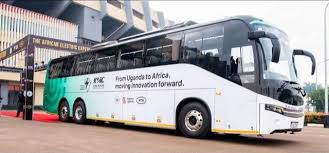
Then came Kayoora — Uganda’s locally manufactured electric bus — and its extraordinary journey from Uganda to Cape Town.
Covering 13,000 kilometres across 13 countries in just 20 days, the Kayoora EV bus tour was not merely a road trip. It was a bold statement about Africa’s capacity to innovate, manufacture, and collaborate at a continental scale.
For a continent that has historically struggled to produce commercially successful automotive products, the very existence of an African-made electric bus is reason enough for celebration. While the Kayoora bus has been in development for several years and is yet to achieve widespread adoption, the tour signalled a turning point — shifting the conversation from possibility to potential execution.
What makes the initiative especially significant is its broader mission: rallying African nations behind a locally made electric vehicle and positioning the continent as an active participant in the global EV value chain.
An executive from Kiira Motors, the company behind the bus, underscored this vision by explaining that the EV presents an opportunity for multiple African countries to contribute to its production. With roughly 70,000 components required to manufacture the bus, each country could specialise in producing specific parts — from tyres and windows to software and advanced vehicle technology.
In this way, the EV bus embodies the promise of the African Continental Free Trade Area (AfCFTA), offering a real, tangible product around which regional industrial collaboration can take shape.
Beyond manufacturing, the initiative opens doors for technological innovation. At a time when Africa continues to lag behind in the global artificial intelligence race — as it has with many past technological waves — the EV bus offers a platform for skills development, experimentation and future-focused problem-solving, particularly in transport and mobility.
For young Africans, it represents a chance to build expertise around a product designed specifically for African conditions — rather than adapting imported technologies that were never meant for local realities.
The timing of the initiative also matters. In 2025, global trade dynamics have continued to shift, with powerful economies increasingly prioritising their own interests and restricting access to opportunities that once supported development elsewhere. In this environment, Africa’s path forward increasingly depends on its ability to develop, own and scale its own products.
The EV bus tour from Uganda to Cape Town presented such a product — not to one nation, but to 13. What happens next depends on whether African governments, investors and manufacturers seize the opportunity to collaborate with Kiira Motors and move toward mass production for both continental and global markets.
In a year crowded with technological noise, Uganda’s EV bus stood out by offering something rare: a credible, African-built solution with the potential to reshape industries, skills and trade across the continent.