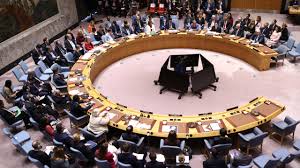
The United Nations Security Council is set to vote Monday on a US-drafted resolution that seeks to reinforce former President Donald Trump’s Gaza peace plan, including the deployment of an International Stabilization Force (ISF). Washington has warned that failure to endorse the plan could restart hostilities between Israel and Hamas.
The proposal—revised multiple times following intense diplomatic negotiations—“endorses” Trump’s peace framework, which enabled a fragile ceasefire to take hold on October 10 after two years of devastating conflict in the Gaza Strip. The war was triggered by the October 7, 2023 Hamas attack on Israel and has since left much of the territory in ruins.
The latest draft, seen by AFP, authorizes the creation of an International Stabilization Force that would operate jointly with Israel, Egypt, and newly trained Palestinian police units. Its responsibilities would include:
Securing Gaza’s border areas
Supporting the demilitarization of Gaza
Overseeing the permanent decommissioning of weapons held by non-state armed groups
Protecting civilians
Ensuring safe humanitarian aid corridors
The resolution also calls for the establishment of a “Board of Peace,” a temporary governing body for Gaza, with a mandate running until the end of 2027. Under the plan, Trump would theoretically chair the board, though the draft does not specify how the role would function in practice.
For the first time, the text acknowledges the potential for a future Palestinian state, stating that once reforms are implemented by the Palestinian Authority and reconstruction of Gaza advances, “the conditions may finally be in place for a credible pathway to Palestinian self-determination and statehood.”
“Our opposition to a Palestinian state on any territory has not changed,” Israeli Prime Minister Benjamin Netanyahu said Sunday.
The vote is scheduled for 5:00 pm (2200 GMT) Monday November 17, 2025.
Veto-wielding Russia has circulated a competing resolution, arguing that the US draft falls short of fully committing to the two-state solution. Moscow’s text urges the Council to reaffirm its “unwavering commitment to the vision of the two-state solution,” and calls on UN Secretary-General Antonio Guterres to present options regarding both the Board of Peace and any international deployment.
The Russian draft does not authorize an international force at this stage.
The United States has accused Moscow of attempting to sow division.
US Ambassador Mike Waltz wrote in The Washington Post:
“Any refusal to back this resolution is a vote either for the continued reign of Hamas terrorists or for the return to war with Israel.”
Arab and Muslim Nations Support US Plan
The United States has released a joint statement showing support from a number of Arab and Muslim-majority states, including Qatar, Egypt, the UAE, Saudi Arabia, Indonesia, Pakistan, Jordan and Turkey. Diplomats say this backing makes the US draft more likely to pass.
Richard Gowan of the International Crisis Group noted that despite Russian concerns, the resolution will likely be adopted.
“The Russians know that while a lot of Council members will go along with the US plans, they share concerns about its substance and Washington’s fast-tracking of it,” he said.
He added that Moscow is unlikely to use its veto—especially given widespread Arab support—and predicted abstentions from both China and Russia.
“It’s more likely they’ll abstain, express skepticism, and then watch the US struggle to implement the plan,” Gowan said.