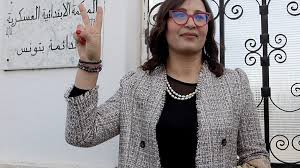
Police in Tunisia on Saturday arrested prominent opposition figure Chaima Issa as she participated in a protest in the capital, marking yet another escalation in what rights groups describe as a deepening crackdown on dissent under President Kais Saied.
Issa’s arrest came just a day after an appeals court issued harsh prison sentences—some as long as 45 years—against several opposition leaders, lawyers, and businessmen. The group was charged with conspiring to overthrow the president, in a ruling widely viewed as politically motivated and indicative of Tunisia’s increasingly authoritarian trajectory.
Moments before her arrest, Issa stood alongside two other convicted politicians and urged Tunisia’s fractious opposition to unite and intensify demonstrations against Saied’s rule.
“They will arrest me shortly,” she warned the crowd, calling on Tunisians to “continue to protest and reject tyranny.”
Issa, who received a 20-year sentence, has consistently maintained that the charges against her are fabricated and meant to silence government critics. Human Rights Watch on Friday condemned the trial as a “travesty of justice,” saying the proceedings were deeply flawed and emblematic of Tunisia’s deteriorating rule of law.
A Deepening Authoritarian Shift
Tunisia, once celebrated as the birthplace of the Arab Spring, has seen dramatic political shifts since July 2021 when President Saied carried out a sweeping power grab—suspending parliament, dismissing the government, and granting himself expanded executive powers to rule by decree.
Since then, dozens of political opponents, journalists, activists, and critics have been arrested or investigated on charges ranging from corruption to plotting against the state. While Saied insists his actions are necessary to end years of political dysfunction and widespread corruption, international observers argue that Tunisia is backsliding into authoritarian rule.
With Issa’s arrest and others expected to follow, fear and anger continue to spread among opposition groups, many of whom say peaceful protest is now their only remaining avenue for resistance.