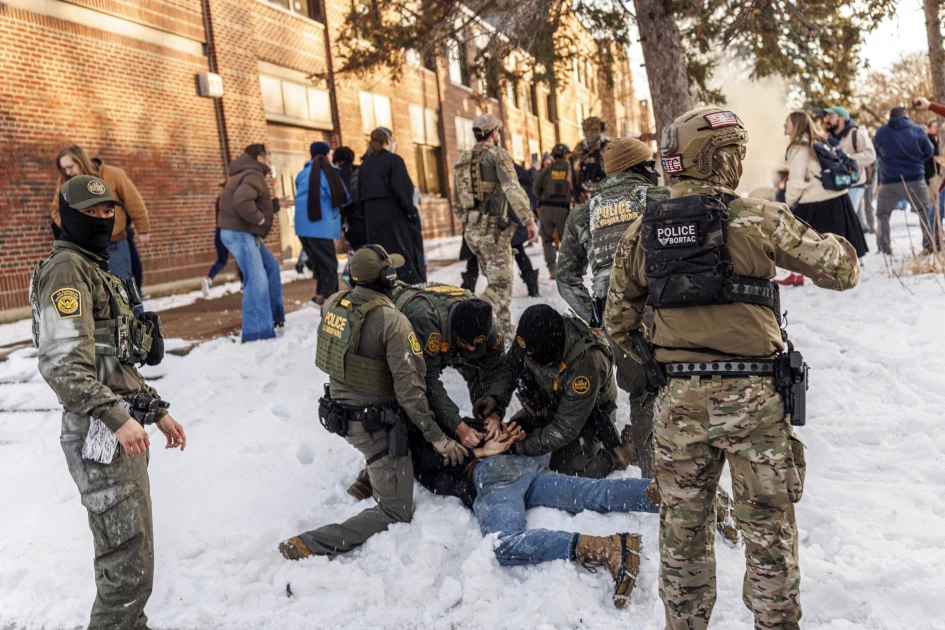
Thousands of people took to the streets of Minneapolis on Friday despite extremely cold weather to protest against U.S. Immigration and Customs Enforcement (ICE) operations in the city. The demonstrations were part of a wider protest movement called “ICE OUT!”, which organizers described as a general strike against President Donald Trump’s immigration crackdown.
Temperatures dropped to as low as minus 20 degrees Fahrenheit (minus 29 Celsius), but protesters still marched through the city. Organizers claimed that up to 50,000 people participated, although police did not confirm the number. Many protesters later gathered indoors at the Target Center, a large sports arena that was more than half full.
The protests come after weeks of tension in Minnesota following increased ICE activity, including raids and arrests. Organizers said many businesses, bars, and restaurants closed for the day as workers joined the demonstrations.
A day before the protests, U.S. Vice President JD Vance visited Minneapolis to show support for ICE officers. He urged local leaders and activists to calm tensions, saying ICE was carrying out its duty to enforce immigration laws.
One of the most dramatic scenes occurred at Minneapolis–Saint Paul International Airport, where dozens of clergy members knelt on a road, sang hymns, and prayed while calling for ICE to leave the state. Police arrested and zip-tied the protesters after they refused to clear the road. Organizers said about 100 clergy members were arrested.
Protest leaders are also demanding justice for Renee Good, a U.S. citizen who was shot dead by an ICE agent earlier this month while monitoring ICE activities. They want the officer involved to be held legally accountable and are calling for a full investigation.
Activists also raised concerns about the detention of U.S. citizens, airport workers, and even school children, including a five-year-old boy. Advocacy group Faith in Minnesota said the protests aimed to highlight what they describe as abuses of power by ICE.
Speakers at the Target Center included indigenous leaders, faith leaders, labor organizers, and community activists. Many accused the federal government of carrying out what they called a “federal occupation” in Minnesota.
President Trump, who was elected in 2024, campaigned on a promise to strictly enforce immigration laws, arguing that his predecessor was too weak on border security. However, critics say his aggressive approach has deepened political divisions and increased fear in immigrant communities.
Some business owners joined the protests by shutting down operations for the day. One of them, Miguel Hernandez, said the action was a sign of solidarity and a message to politicians to do more than just speak on television.
Large corporations based in Minnesota, including Target, have so far remained silent on the ICE operations, drawing criticism from protest leaders who say companies should speak out.
As protests continue, demonstrators say they will keep pushing for ICE to leave Minneapolis and for greater accountability from the federal government.