One of the most difficult questions in African history is rarely discussed openly:
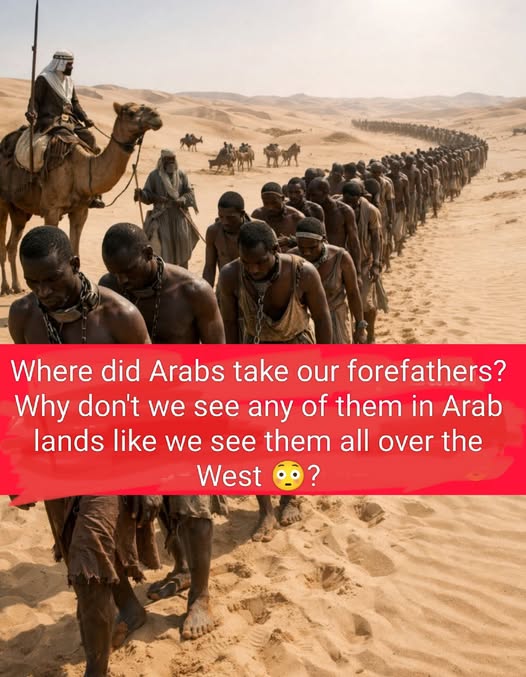
What happened to the millions of Africans taken during the Arab–Indian Ocean slave trade, and why are there no large, visible Black populations in many Arab countries today, unlike in the Americas and Europe?
This is not a question meant to provoke hatred, but one that demands honest historical reflection.
The Arab–Indian Ocean Slave Trade
For over a thousand years, Africans were captured and traded through networks stretching across East, Central, and Southern Africa. Communities in present-day Kenya, Tanzania, Mozambique, Madagascar, Malawi, Zambia, and Zimbabwe were affected.
Many captives were transported through Zanzibar and Mombasa, which became major slave markets. From there, enslaved Africans were taken across the Indian Ocean and Red Sea to regions that today include Saudi Arabia, Oman, Yemen, Iraq, Iran, Syria, as well as parts of India and Persia.
This trade predated European colonial slavery and continued well into the late 19th century.
Why Are Large Black Communities Rare in Arab Lands?
Historians point to several key reasons why African-descended populations did not grow in the same way they did in the Americas:
High Mortality Rates
Enslaved Africans faced brutal conditions, harsh labor, disease, and violence. Many did not survive long enough to form families.
Use of Enslaved Men as Eunuchs
Historical records confirm that some enslaved African males were castrated, particularly those assigned to guard royal courts or harems. This practice was extremely dangerous and caused very high death rates, preventing reproduction.
Restrictions on Family Formation
Enslaved Africans were rarely allowed to form independent families. Childbearing among enslaved men and women was often discouraged or controlled.
Assimilation and Loss of Identity
Enslaved African women were sometimes absorbed into households as domestic workers or concubines. Children born from these unions were typically raised as Arabs or Persians, adopting their father’s language, religion, and identity. Over generations, African origins were often erased.
Lack of Emancipation Systems
Unlike in the Americas, where large enslaved populations eventually gained freedom and formed distinct Black communities, there were few systems that allowed formerly enslaved Africans in Arab lands to live as free, independent communities.
Culture, Religion, and Power
Religion played a complex role. While Islam formally discouraged racial hierarchy, in practice many enslaved Africans were forced to convert, and rejection often meant punishment or death. Survival frequently depended on submission and assimilation.
Over time, African cultural practices were suppressed, and many descendants lost all connection to their African roots.
A Silenced History
Today, slavery is rarely discussed openly in many Arab societies. School curricula often omit or minimize the history of African enslavement. As a result, many people remain unaware of how deeply the slave trade shaped their societies.
However, traces remain. Communities such as Afro-Omanis, Afro-Saudis, Afro-Iraqis, and Afro-Zanzibaris still exist, though they are often marginalized and underrepresented.
Why This History Matters
This history matters not to assign collective guilt, but to acknowledge truth, honor the victims, and understand how power, race, and silence shape societies.
Africa lost millions of people—men, women, and children—whose stories were never told, whose descendants were absorbed or erased, and whose suffering remains largely unrecognized.
A Question for Reflection
Why has this history remained so quiet?
What does acknowledgment look like today?
And how can honest dialogue help heal wounds that were never allowed to close?