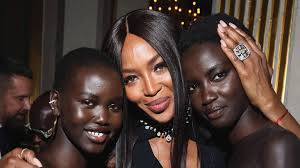
South Sudan, one of Africa’s youngest and least developed nations, is fast becoming a powerhouse in the global fashion industry. From Paris to Milan and New York, South Sudanese models are dominating runways, campaigns, and magazine covers, earning praise for their striking features, poise, and resilience.
Among them is Arop Akol, a 20-something model who has walked for top brands in London and Paris and even shared the runway with Naomi Campbell at an Off-White show. Speaking to the BBC in London, she said her passion for modelling began when she was 11 years old.
“South Sudanese people have become very well known for their beauty,” Akol said, describing how she often meets fellow South Sudanese models while travelling for work.
Akol is part of a growing wave of South Sudanese talent, including Adut Akech, Anok Yai, and Alek Wek — all of whom have achieved global recognition. Alek Wek, discovered in London in 1995, was the first South Sudanese model to achieve international fame, paving the way for others who followed.
The trend shows no sign of slowing down. According to Models.com, one in every five of the top 50 “future stars” in fashion now has South Sudanese heritage. In 2025, Vogue magazine also featured four South Sudanese models among the 11 young faces “set to storm the catwalks.”
Industry insiders say South Sudanese models are admired for their tall, slender frames, rich dark skin, and confident presence. Dawson Deng, founder of South Sudan Fashion Week, explains:
“They have the perfect dark skin, the height, the confidence — everything fashion looks for.”
But casting agents say it’s not just about looks. Akur Goi, another South Sudanese model who has worked with Givenchy and Armani, believes it’s their resilience and discipline that make them stand out.
“Many of us grew up as refugees or came from conflict zones,” Goi said from Milan. “We know how to work hard because we’ve struggled to reach where we are.”
South Sudan gained independence from Sudan in 2011, but civil war broke out just two years later, killing around 400,000 people and forcing 2.5 million to flee their homes. Many families sought refuge in neighbouring countries such as Uganda and Kenya — the same places where several models, including Akol and Goi, grew up.
Despite their success stories, not all South Sudanese models have had easy journeys. Some were exploited early in their careers by fake agencies demanding payment for “registration fees.” Others, according to reports, were flown to Europe only to be told they were too undernourished to model and later charged thousands of euros for travel costs.
Akol herself says she faced such treatment when first scouted in 2019, before finding a trustworthy agency years later.
Back home, modelling is still misunderstood. Some conservative families see it as inappropriate for young women. “My family didn’t want me to do it,” Akol said. “But we had to show that modelling can be a career, not a shameful thing.”
Dawson Deng recalls a young woman whose family once stopped her at the airport to prevent her from travelling for a modelling job. Today, she is a top model supporting her entire family.
“She’s paying school fees for all her siblings,” he said. “Now everyone is proud of her.”
With fashion houses increasingly embracing diversity, South Sudanese models are now seen as symbols of strength and authenticity. Many of them use their platforms to promote African culture and inspire young people in their homeland.
As Akol put it:
“Alek Wek started before I was even born — and she’s still going strong. South Sudanese models are going to go a long way.”
From refugee camps to global catwalks, these women have turned their struggles into stories of triumph — and in doing so, they’ve helped reshape what beauty means to the world.