South African President Cyril Ramaphosa announced on Friday November 14, 2025, that South Africa would symbolically pass the presidency of the G20 to an “empty chair” at next week’s summit in the absence of U.S. leadership. This move comes after U.S.
President Donald Trump confirmed that no U.S. government officials would attend the Group of 20 summit in South Africa on November 22-23.
Trump’s decision to forgo the summit stems from his allegations of “human rights abuses” in South Africa, specifically his widely debunked claims that white South Africans are being “slaughtered” and driven off their land. These assertions have sparked significant controversy, as they are not supported by credible evidence.
Trump has also made headlines by stating that refugee admissions to the U.S. this year would primarily focus on Afrikaners—the descendants of Dutch settlers who make up South Africa’s white population.
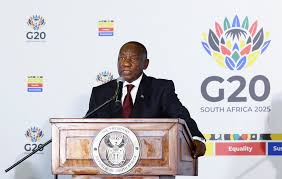
In response to this diplomatic snub, President Ramaphosa expressed his frustration with the situation. “I have said in the past, I don’t want to hand over to an empty chair, but the empty chair will be there,” Ramaphosa remarked at a press conference in Soweto, where he was overseeing preparations for the upcoming summit.
“I will probably symbolically hand over to that empty chair and then talk to President Trump,” he added, acknowledging the symbolic nature of the handover.
South African officials have repeatedly denied Trump’s claims, which they argue misrepresent the situation in the country.
South Africa remains a Black-majority nation, where government officials insist that racial discrimination does not take place against any group, including the Afrikaners. The U.S. president’s stance on the matter has caused growing exasperation among South African leaders.
Despite this diplomatic setback, Ramaphosa underscored the importance of maintaining robust economic relations with the United States, one of South Africa’s largest trade partners.
“We export products to that country, and in the end, they don’t end up in the White House, they end up in the hands of consumers in the United States,” Ramaphosa explained.
“There could well be a view that we should not engage with the United States. But sometimes, you have to talk to people who may not be very friendly… to advance the interests of your own people.”
While Ramaphosa did not shy away from expressing his displeasure over Trump’s stance, his comments reflected the broader diplomatic challenge: balancing national interests with the need for international engagement, even with countries where relations may be strained.