Somalia and several African nations, led by the African Union (AU), strongly condemned Israel on Friday after it became the first country to formally recognise Somaliland as an independent and sovereign state, a move that has sparked diplomatic outrage and raised concerns over regional stability.
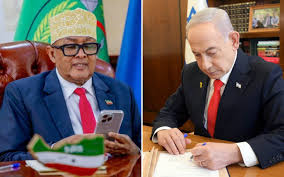
Somaliland, a self-declared republic in northern Somalia, unilaterally declared independence in 1991 following the collapse of Somalia’s central government. Despite maintaining its own government, currency, passports and security forces, the territory has remained diplomatically isolated for more than three decades as it seeks international recognition. President Abdirahman Mohamed Abdullahi has made formal recognition a central pillar of his administration since taking office last year.
Israel announced on Friday that it now views Somaliland as an “independent and sovereign state,” prompting an immediate and sharp response from Mogadishu. Somalia’s government described the move as a “deliberate attack” on its sovereignty and warned that it would undermine peace and stability in the Horn of Africa.
The African Union echoed those concerns, rejecting Israel’s decision and cautioning that it risked “setting a dangerous precedent with far-reaching implications for peace and stability across the continent.” AU Commission Chairperson Mahamoud Ali Youssouf stressed that Somaliland “remains an integral part” of Somalia, an AU member state, and reaffirmed the bloc’s commitment to the principle of territorial integrity.
Israel’s Prime Minister Benjamin Netanyahu said the recognition was made “in the spirit of the Abraham Accords,” referring to agreements brokered during US President Donald Trump’s first term that normalised relations between Israel and several Arab countries. Netanyahu’s office also confirmed that he had invited Somaliland President Abdullahi to visit Israel, signalling a willingness to deepen bilateral ties.
Asked by the New York Post whether the United States would follow Israel’s lead and recognise Somaliland, President Trump responded in the negative. “No,” he said, adding dismissively: “Does anyone know what Somaliland is, really?”
In contrast, President Abdullahi welcomed Israel’s move, calling it a “historic moment” and saying it marked the beginning of a “strategic partnership.” Celebrations erupted in Hargeisa, Somaliland’s capital, where crowds gathered in the streets waving flags of the breakaway region, according to local sources.
The decision also drew condemnation from the Palestinian Authority, which accused Israel of previously identifying Somaliland as a potential destination for the forced displacement of Palestinians, particularly from the Gaza Strip. The authority warned against any “complicity” in such plans.
Turkey, a key ally of Somalia, criticised Israel’s recognition as “overt interference” in Somalia’s domestic affairs, accusing Israel of pursuing an expansionist agenda. Egypt also weighed in, saying its foreign minister had held consultations with counterparts from Turkey, Somalia and Djibouti, during which they reaffirmed their “full support for the unity, sovereignty and territorial integrity of Somalia.”
In a video released by Israeli officials, Netanyahu was seen speaking by phone with Abdullahi, expressing optimism that the new relationship would create economic opportunities. “I am very, very happy and I am very proud of this day, and I want to wish you and the people of Somaliland the very, very best,” Netanyahu said.
Analysts suggest Israel’s decision may be driven by strategic considerations. Somaliland occupies a critical position along the Gulf of Aden and near the Red Sea, a region of growing security importance. According to Israel’s Institute for National Security Studies, Israel is seeking allies in the Red Sea corridor, particularly in light of tensions with Yemen’s Iran-backed Houthi rebels.
Israel has carried out multiple strikes in Yemen since the outbreak of the Gaza war in October 2023, responding to Houthi attacks on Israel that the group said were in solidarity with Palestinians. Those attacks have largely halted since a fragile truce in Gaza began in October.
For Somaliland, international recognition could unlock access to foreign investment, loans and development aid, all of which have been limited by its unrecognised status. The territory remains economically fragile, despite relative political stability compared to much of southern Somalia.
The issue of Somaliland’s status has already strained regional relations. Last year, Somalia strongly objected to a deal between Somaliland and landlocked Ethiopia that would allow Addis Ababa to lease a stretch of coastline for a port and military base.
Israel’s recognition comes as it seeks to expand diplomatic ties in Africa and the Middle East, building on agreements reached in 2020 with countries such as the United Arab Emirates and Morocco. However, ongoing conflicts—particularly the war in Gaza—have complicated efforts to further normalise relations across the region.