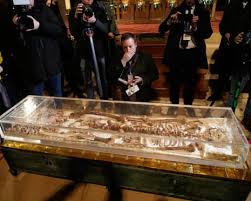
For the first time in history, the skeleton of Saint Francis of Assisi is being shown to the public in full view at the Basilica of Saint Francis of Assisi.
The special display began on Sunday and will continue until 22 March. It marks 800 years since the saint’s death in 1226. Church leaders expect hundreds of thousands of visitors to travel to the hill town of Assisi to see the remains.
A Rare and Historic Display
The bones are placed inside a sealed, nitrogen-filled case. On the case are the Latin words “Corpus Sancti Francisci,” which mean “The Body of Saint Francis.” For extra protection, the case is kept inside another bulletproof glass covering, and security cameras are operating day and night.
Although the saint’s tomb was moved to the basilica in 1230, it was secretly rediscovered in 1818 after careful excavation work. Since then, his remains have rarely been seen. They were displayed only once before, in 1978, and only for a small group of people for one day.
This is the first time the skeleton is being shown publicly for an extended period.
Who Was Saint Francis?
Saint Francis died on 3 October 1226. He is known for giving up his wealth and choosing to live a simple life devoted to the poor. He founded the Franciscan order, which continues to serve communities around the world.
Church officials say the condition of his bones shows how much he sacrificed during his lifetime. They hope the display will inspire both believers and non-believers.
Large Crowds Expected
Normally, the basilica receives about 1,000 visitors on weekdays and up to 4,000 on weekends. But during this special exhibition, the number is expected to rise to about 15,000 visitors per weekday and nearly 19,000 on weekends.
So far, almost 400,000 people from around the world have made reservations. Most visitors are from Italy, but many are also coming from Brazil, North America, and Africa.
Saint Francis is Italy’s patron saint, and a public holiday on 4 October will be restored this year to honor the 800th anniversary of his death.
Respectful and Careful Preservation
Church leaders have stressed that the display is not meant to be shocking or disturbing. Christians have honored the relics of saints for centuries. Experts also confirmed that the bones will not be damaged because the case is sealed and protected from outside air and light.
The basilica will remain softly lit during the exhibition. As one church official explained, this is a sacred moment, not a show.