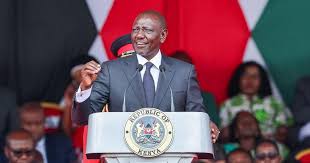
Nairobi, December 12, 2025 — President William Ruto has unveiled a new National Infrastructure Fund (NIF), aiming to transform how Kenya finances development projects and reduce reliance on borrowing and heavy taxation.
Speaking during Jamhuri Day celebrations, the President said the Fund, set for Cabinet approval on Monday, will channel resources from state asset sales directly into long-term infrastructure, rather than using them to cover routine government expenses.
A New Approach to Development Financing
Ruto described the NIF as a mechanism to align financial resources with national development priorities. The Fund will use proceeds from privatised state assets, attract long-term investments, and allow Kenyans to participate in infrastructure financing through capital markets.
“For years, revenue from the sale of assets like Kenya Airways or KenGen went straight into the national budget, mostly to pay salaries or service public debt. That cycle ends now,” he said.
Under the new model, all current and future privatisation proceeds will go exclusively into projects such as roads, energy systems, water infrastructure, and other strategic public investments.
Mobilising Investment
President Ruto highlighted that each shilling placed in the Fund could attract at least ten times more from pension schemes, international investors, development partners, and sovereign wealth funds. The country needs nearly Sh5 trillion for four priority national projects, a cost the President acknowledged as high but essential.
“Borrowing more worsens our debt burden, raising taxes strains families, and relying solely on the national budget would take decades. Inaction is not an option,” Ruto said.
Energy Expansion and Governance Reforms
A key focus of the NIF is rapid expansion of Kenya’s energy capacity. With current output at 3,300MW, the President said the country must generate an additional 10,000MW within seven years to support industries, data centres, electric mobility, and an emerging AI-driven economy.
Ruto also pointed to reforms under the Government-Owned Enterprises Act, which introduces merit-based appointments and reduces political influence in state corporations.
Sovereign Wealth Fund and Strategic Savings
Alongside the NIF, the Cabinet will review the Sovereign Wealth Fund Policy, designed to safeguard savings for future generations, cushion the economy from shocks, and strategically invest in national priorities.
The President revealed that the framework was shaped through discussions with senior political figures, including the late Raila Odinga and former President Uhuru Kenyatta.
“Monday begins a new chapter,” he said. “One where Kenya finances development through strength, not struggle.”