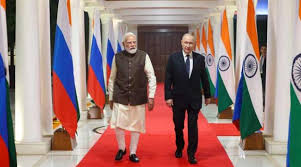
Russian President Vladimir Putin and Indian Prime Minister Narendra Modi on Friday reaffirmed their longstanding strategic partnership, agreeing to significantly expand trade and diversify economic cooperation despite mounting Western pressure on New Delhi to loosen its ties with Moscow.
Putin’s two-day visit—his first trip to India since the start of Russia’s 2022 invasion of Ukraine—was marked by warm receptions, high-level talks, and symbolic gestures reflecting the depth of the two countries’ relationship. India, which has grown increasingly reliant on Russian arms and discounted seaborne oil, rolled out a red carpet welcome for the Russian leader, including a formal 21-gun salute at the presidential palace.
The visit comes at a delicate geopolitical moment, as New Delhi negotiates with Washington to remove punitive tariffs imposed by President Donald Trump over India’s purchases of Russian oil. The balancing act underscores India’s complex diplomatic challenge: maintaining its historic ties with Moscow while navigating an assertive U.S. trade agenda.
Russia signaled that its economic engagement with India must become more balanced, with Putin stating that Moscow wants to import more Indian goods and push bilateral trade to $100 billion by 2030. Currently, trade heavily favors Russia due to India’s large energy purchases.
Prime Minister Modi described India’s partnership with Russia as “a guiding star,” calling the relationship one built on “mutual respect and deep trust.”
“We have agreed on an economic cooperation programme for the period up to 2030,” Modi said. “This will make our trade and investment more diversified, balanced, and sustainable.”
Modi also restated India’s support for a peaceful resolution to the war in Ukraine—an issue on which New Delhi has consistently walked a diplomatic tightrope.
Putin assured India of “uninterrupted fuel supplies,” signaling Russia’s intent to continue energy cooperation despite U.S. sanctions. He also highlighted ongoing progress at the Kudankulam nuclear power plant, which is set to become India’s largest once completed.
A joint statement issued after the summit stressed that Indo-Russian relations “remain resilient to external pressure,” a clear reference to Western efforts to isolate Moscow over its actions in Ukraine.
Both sides signed a range of agreements, including initiatives to facilitate Indian workers’ migration to Russia, establish a joint fertilizer production plant, and expand cooperation in agriculture, shipping, and healthcare.
In defence, the two sides agreed to upgrade their collaboration by including joint research, development, and manufacturing. This aligns with India’s push for greater military self-reliance under the “Make in India” initiative. The new framework includes joint production of spare parts and components for servicing Russian-made military equipment.
In an interview with India Today, aired Thursday evening, Putin challenged Washington’s stance on India’s purchases of Russian fuel.
“If the U.S. has the right to buy our (nuclear) fuel, why shouldn’t India have the same privilege?” he said, adding he planned to discuss the matter with Trump directly.
Putin insisted that energy trade between Russia and India continues to run smoothly despite a slight decline in volumes earlier in 2025.
India, which has argued that Trump’s tariffs are “unjustified and unreasonable,” points out that both the U.S. and European Union continue to import billions of dollars’ worth of Russian energy despite sanctions.
Analysts say India faces a diplomatic dilemma as it attempts to balance its interests between Moscow and Washington.
“By taking steps to strengthen ties with Moscow or Washington, New Delhi risks setting back ties with the other,” noted Michael Kugelman of the Atlantic Council in a recent commentary.
As Putin’s state visit concludes, the message from both capitals is clear: Russia and India intend to deepen their partnership across economic, energy, and defence sectors, regardless of external geopolitical pressures.
With new agreements in place and long-term cooperation frameworks outlined, the two nations are positioning their decades-old relationship to withstand shifting global power dynamics well into the next decade.