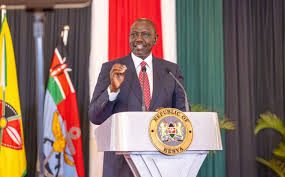
In his New Year address, President William Ruto delivered a stark warning to drug traffickers, proposing the death penalty as a solution to Kenya’s growing drug crisis. The President’s message highlighted how the country’s widespread drug, alcohol, and substance abuse problem is undermining the nation’s economic progress. Ruto stated that the rampant abuse had reached critical levels, stagnating economic development and threatening the health and well-being of Kenya’s citizens.
According to Ruto, one of the key barriers to achieving Kenya’s ambitious target of a Ksh. 5 trillion economy is the devastating toll of drug use. He pointed out that the illicit drug trade is not only fueling crime and insecurity but is also undermining productivity, particularly among the youth, who make up a large portion of the drug-affected population.
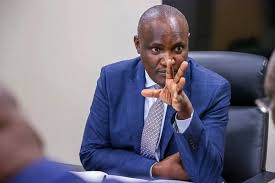
In an exclusive interview with Citizen TV, Interior and National Administration Cabinet Secretary Kipchumba Murkomen supported the President’s stance. Murkomen drew comparisons with countries like the Philippines, Malaysia, and China, where the death penalty is imposed on those caught trafficking drugs. He emphasized that Kenya cannot aspire to become a first-world nation while drugs and alcohol destroy its most productive generation.
“Drugs are wiping out the youth and stealing the potential of millions of Kenyans,” said Murkomen. “In countries like Malaysia and China, people are executed for trafficking in narcotics. The current legal system in Kenya, with its lenient penalties, encourages further drug trafficking.”
Murkomen also pointed out that many offenders walk away with minor fines, which only serve to embolden traffickers and sellers of illicit alcohol. “The fines are so low, it’s become a business risk worth taking for many,” he remarked, urging for harsher penalties and stricter enforcement of the law.
In response to the escalating crisis, the government plans to overhaul the Anti-Narcotics Unit (ANU) within the Directorate of Criminal Investigations (DCI), aiming to bolster its capabilities to match those of specialized units like the Anti-Terrorism Police Unit (ATPU). Murkomen revealed that meetings would soon be held with the Inspector General of Police to discuss ways to enhance the capacity of the Anti-Narcotics Unit and ensure effective targeting of drug barons and illicit alcohol manufacturers.
“The problem with the drug trade is not just on the streets, it’s often hidden behind legitimate businesses,” Murkomen explained. “We will start with the big players and ensure they are brought to justice. No one will be spared.”
Statistics paint a grim picture of the state of substance abuse in Kenya. According to government reports, one in every six Kenyans aged between 15 and 65 is involved in using at least one illicit drug or substance. This equates to over 4.7 million individuals across the country. Among men, the rate is even higher, with one in every three men using drugs or alcohol. The most common substance used is alcohol, with over 3.2 million current users.
The youth are especially vulnerable, with one in five young adults between the ages of 25 and 35 affected by drug and alcohol use. Ruto’s government has acknowledged the need for urgent intervention to prevent the next generation from succumbing to addiction and its devastating consequences.
The administration’s approach to curbing the drug menace is multi-faceted, combining stricter penalties with increased enforcement efforts. Murkomen underscored the importance of a united national effort to confront this crisis. “Nearly every family in Kenya is affected by addiction in some way,” he said. “This is not just a law enforcement issue; it’s a national emergency that requires every Kenyan’s support.”
While the President’s proposal for the death penalty has sparked debate, the government is focused on strengthening its fight against drug trafficking and abuse. The restructured Anti-Narcotics Unit will work closely with international partners to ensure that drug traffickers and dealers are caught and held accountable for their actions.
As Kenya tackles the severe consequences of drug trafficking, it remains to be seen how this radical policy will affect both the legal landscape and the wider fight against addiction in the country. For many, the hope is that these actions will bring about a decisive change, freeing the nation from the grip of drugs and alcohol that has claimed so many lives.