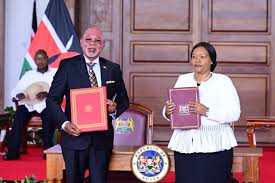
KAMPALA — Veteran Ethiopian aviation expert Girma Wake on Wednesday held high-level talks with President Yoweri Museveni at State House Entebbe, as Uganda Airlines grapples with a deepening leadership and governance crisis following the exit of its Chief Executive Officer, Jennifer Bamuturaki Musiime.
The meeting comes at a pivotal moment for the national carrier, which has formally advertised for a substantive CEO after Bamuturaki’s departure, ending nearly five years at the helm, including a prolonged period in an acting capacity.
Although the advertisement sets the minimum age for applicants at 60 years, Wake—who is 82—is widely expected to assume an interim leadership and advisory role, while guiding the search for a permanent chief executive. His appointment, however, remains subject to formal vetting scheduled for next week.
A strategic intervention
Wake’s entry into Uganda Airlines is being viewed as a calculated move to stabilise the carrier amid persistent operational, governance, and financial challenges. Since its relaunch, the airline has struggled to balance political expectations with the commercial discipline required to run a sustainable, competitive airline.
A former long-serving CEO of Ethiopian Airlines, Wake is widely credited with transforming the Addis Ababa-based carrier into Africa’s most profitable and globally competitive airline. During his tenure from 2004 to 2011, Ethiopian Airlines underwent extensive fleet modernisation, expanded its route network, strengthened its position within the Star Alliance, and entrenched corporate governance systems designed to insulate operations from political interference.
Uganda Airlines’ troubled journey
Uganda Airlines was relaunched in 2019 with ambitions of boosting tourism, facilitating trade, and restoring national pride. The government invested heavily in the acquisition of Bombardier CRJ900 regional jets and Airbus A330-800neo wide-body aircraft, positioning Entebbe as a potential regional aviation hub.
Despite these investments, the airline has posted consistent losses and attracted sustained criticism over procurement practices, governance standards, and human resource management.
Bamuturaki’s tenure came under intense scrutiny, culminating in multiple investigations. In 2024, Parliament’s Committee on State Authorities and State Enterprises (COSASE) launched a probe into the airline’s continued financial underperformance.
This was followed by joint investigations by the Criminal Investigations Directorate (CID) and the State House Anti-Corruption Unit, which examined allegations of mismanagement, corruption, and abuse of office. These investigations ran alongside an internal inquiry by the airline’s Board of Directors, which summoned Bamuturaki and her senior management team to respond to accusations ranging from procurement irregularities to decisions blamed for long-term financial losses.
Auditor General and COSASE findings
Auditor General reports further exposed structural weaknesses within the airline, including uncontrolled salary growth, the absence of a clear staff structure, and qualification gaps among senior officials.
At the centre of the COSASE inquiry was a Shs237.8 billion loss recorded in the 2023/2024 financial year. While investigators attributed the losses to mismanagement, inflated payments, and high aircraft maintenance costs, Bamuturaki and her team argued that external factors—such as rising global jet fuel prices, aircraft leasing costs, spare parts shortages, and depreciation—had severely affected profitability.
Parliamentary committee members, however, faulted the airline for acquiring ageing aircraft without adequately evaluating the long-term maintenance and cost implications.
Mounting allegations and public frustration
Additional allegations levelled against management included an internal ticketing scam reportedly costing the airline USD 253,189, violations of the Public Procurement and Disposal of Assets Act, embezzlement, and general abuse of office.
Public confidence in Uganda Airlines further deteriorated over the past year amid frequent flight disruptions, with delays stretching from hours to days, unexplained cancellations, and poor communication with passengers drawing sharp criticism.
The Board demanded explanations over the lack of timely information to stranded passengers and sought detailed records outlining the number of affected travellers, the causes of disruptions, and the resulting financial impact.
The turning point
Sources say a State House meeting chaired by President Museveni in September 2025 proved decisive. Bamuturaki reportedly failed to satisfactorily explain the airline’s poor performance and was dismissed from the meeting in frustration—a moment widely believed to have sealed her fate.
In an internal circular issued earlier this week, Bamuturaki informed staff that the CEO position would soon be advertised and encouraged qualified employees to apply. Some insiders interpreted the move as an early signal of her departure or an attempt to ease internal tensions ahead of an official announcement.
Other sources, however, suggest the decision to replace her came too late, with Wake already identified as the preferred stabilising figure to guide the airline through its next phase.
A signal of reform
Born in 1943, Wake remains one of Africa’s most respected aviation managers. Beyond his earlier tenure as CEO of Ethiopian Airlines, he also served as board chairman between 2022 and 2023.
For Uganda Airlines, his involvement is being interpreted as more than a stopgap measure. It signals an attempt to inject professional airline management, commercial discipline, and governance rigor into a carrier long criticised for inefficiency and political interference.
As Uganda Airlines searches for a new chief executive, all eyes will be on whether Wake’s influence can help reset the airline’s trajectory and restore confidence in a national symbol that has struggled to live up to its ambitions.