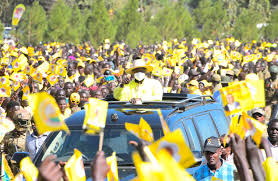
President Yoweri Kaguta Museveni while campaigning in Lira City, where he reiterated that peace remains the most important foundation for Uganda’s social and economic transformation and warned individuals seeking to undermine the country’s stability.
Addressing a large crowd during the National Resistance Movement (NRM) campaign event, President Museveni said the peace ushered in by the NRM government since 1986 is the party’s first and most critical contribution to Uganda, without which development would not be possible.
“Peace is the foundation of everything. No one should dare disturb Uganda’s peace,” Museveni said, recalling that before the NRM assumed power, Uganda was characterised by prolonged political instability, armed conflict, cattle rustling and widespread insecurity that crippled economic activity.
He explained that development is the second major NRM achievement, noting that progress in infrastructure, energy, agriculture and industrialisation has only been possible because of sustained peace. As an example, Museveni cited Mandela National Stadium (Namboole), whose construction had been proposed by the Chinese as early as 1968 but could not be realised at the time due to insecurity.
“Because of the peace brought by the NRM, we were able to build Namboole and other stadiums such as Akii-Bua Stadium here in Lira, Hoima Stadium, and to undertake major projects like the Karuma Hydropower Dam,” he said, adding that government plans are underway to develop additional power plants, including Ayago, to meet Uganda’s growing energy needs.
The President also highlighted Uganda’s oil and gas sector, noting that although British explorers attempted to search for oil in the Albertine Graben in the 1920s, it was only under a stable and peaceful environment—combined with modern technology—that Uganda was able to confirm commercially viable oil reserves. He said oil production is expected to commence this year, marking a significant milestone in the country’s economic development.
Turning to environmental conservation and agriculture, Museveni cautioned residents of Lango, Teso and Acholi sub-regions against the destruction of wetlands. He emphasised that swamps play a critical role in water storage, irrigation and fish farming, especially in the face of climate change.
He explained that communities can engage in fish farming along the edges of wetlands while preserving the core swamp areas to support irrigation for crops grown on dry land.
“Lango, Teso and Acholi are very lucky because of these swamps. Fish farming and irrigation can give very high yields on small pieces of land,” Museveni said, citing his own farm where he harvests up to 53 tonnes of matooke per hectare using irrigation.
He revealed that government plans are in place to systematically develop fish farming projects along wetlands across the three sub-regions as part of boosting household incomes and food security.
On livestock restocking, the President said government had previously released Shs159 billion to compensate communities in Lango, Acholi and Teso for cattle lost during past conflicts, although the impact was limited. He noted that government had proposed a household-based restocking programme, providing three to five cows per family, but local leaders opted for monetary compensation after consulting their communities.
“The money is available, but it will be given after proper scrutiny of beneficiary lists to ensure it reaches the right people,” he said.
Museveni identified wealth creation as the third key NRM contribution, urging households to move beyond subsistence farming by combining it with commercial agriculture. He revisited the four-acre model first introduced in the 1996 NRM manifesto, encouraging small-scale farmers to invest in enterprises such as coffee, bananas, piggery and poultry.
He cited the Minister of State for Transport, Fred Byamukama, as an example of successful wealth creation on just four acres of land.
The President also highlighted government-led wealth creation initiatives, including Entandikwa, Operation Wealth Creation, Emyooga and the Parish Development Model (PDM), under which every adult parish member can access up to Shs1 million through parish SACCOs to support income-generating activities.
On employment, Museveni noted that sustainable job creation comes from industrialisation, commercial agriculture, services and the ICT sector, rather than relying solely on government jobs.
NRM Vice Chairperson for Northern Uganda, Hamson Obua, said the next NRM term would deliver even greater transformation, citing ongoing infrastructure projects and wealth creation programmes already visible in Lira and the wider region.
Meanwhile, Lira City NRM Chairperson and Minister of Health, Dr Ruth Aceng, commended President Museveni for his long-standing cooperation with the Lango sub-region. She thanked him for key projects such as Akii-Bua Stadium and the Uganda Support to Municipal Infrastructure Development (USMID) programme, which has resulted in the tarmacking of more than 30 kilometres of roads in Lira City.