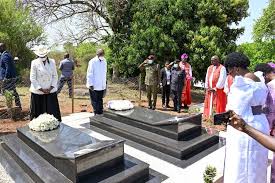
President Yoweri Kaguta Museveni has honoured the legacy of martyred Anglican leader Janani Luwum, urging leaders to embrace persuasion, service and moral integrity rather than intimidation and violence.
Speaking during the annual commemoration of Luwum’s martyrdom in Kitgum District, the President reflected on Uganda’s turbulent past under Idi Amin and cautioned against leadership rooted in fear.
“Amin ruled me only for a few hours,” Museveni said, stressing that leaders should never impose themselves on citizens but instead win their support through good service and example.
Leadership Through Service, Not Fear
Drawing from biblical teaching, Museveni said leaders must allow their good deeds to shine before others. He warned that any leader who relies on intimidation repeats the same mistakes that defined Amin’s regime.
The President described Amin’s second major mistake as the use of killings to silence dissent. While acknowledging Uganda’s history of armed struggle, Museveni emphasized that he has consistently rejected assassinations and attacks on individuals outside the battlefield.
He recalled turning down a proposal by some fighters to assassinate then–army commander Oyite Ojok at his home, insisting that such an act would amount to cowardice. Even in war, he said, both the cause and the methods used must be just.
Museveni noted that those responsible for atrocities during Amin’s regime ultimately failed, adding that the sacrifices of leaders such as Luwum and Ben Kiwanuka were not in vain.
Development and Peace in Northern Uganda
Turning to national development, the President thanked the people of Northern Uganda for their electoral support, attributing it to sustained government investment in infrastructure and service delivery.
He cited the extension of electricity beyond Lira, improved roads, schools, health centres and access to clean water, which he said helped eliminate diseases such as guinea worm. Museveni also highlighted ongoing efforts to transition households into the money economy, pointing to initiatives such as the Parish Development Model aimed at lifting the remaining families out of subsistence living.
The President further pledged to personally address reports of cattle rustling in East Acholi and fulfilled a Shs60 million pledge to priests of Kitgum Diocese.
Church Leaders Reflect on Luwum’s Legacy
Archbishop of the Church of Uganda, Stephen Samuel Kaziimba Mugalu, welcomed pilgrims from across the country, saying the Church continues to celebrate Luwum’s life and martyrdom as a testimony of faith and justice.
“This celebration is not just about an individual; it is about faith, justice and the values he preached,” Kaziimba said, noting that churches and schools across Uganda bear Luwum’s name.
The Bishop of Lango Diocese, Alfred Olwa, commended the organizing committee and called for renewed courage and unity as Uganda approaches the golden jubilee of Luwum’s martyrdom.
Minister of State for Ethics and Integrity, Rose Lilly Akello, revealed plans to develop Luwum’s site into an international pilgrimage centre. She said the family had offered land, a draft master plan had been completed, and projects including a primary school, hospital and administrative block were underway.
Kitgum District Woman MP and Minister of State for Disaster Preparedness, Lillian Aber, praised Luwum’s enduring moral influence, especially among the Acholi people, noting that the region now enjoys peace after decades of insurgency.
A Legacy That Endures
Arrested and killed in 1977 after presenting a protest letter condemning state violence, Archbishop Janani Luwum remains one of Uganda’s most prominent religious martyrs. Nearly five decades later, his commemoration continues to serve as both a remembrance of sacrifice and a reflection on leadership anchored in unity, peace and stability.
The event drew ministers, members of parliament, religious and cultural leaders, and thousands of faithful from across Uganda, reaffirming Luwum’s enduring influence on the nation’s spiritual and civic life.