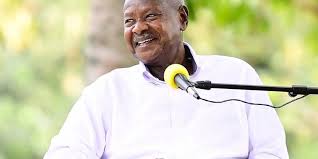
In his Presidential End-of-Year Address, President Yoweri Kaguta Museveni hailed Uganda’s significant economic progress over the past four decades, emphasizing the country’s transformation from a post-conflict recovery phase to a rapidly growing, knowledge-based economy. Museveni outlined Uganda’s economic journey, noting key milestones and the country’s impressive achievements, which have led it to achieve lower-middle-income status.
Reflecting on Uganda’s economic history, the President described the country’s progress through five distinct phases: recovery after conflict, expansion of the colonial economy, diversification into cash commodities, value addition in key sectors, and finally, the transition to a knowledge economy. Museveni expressed pride in how far Uganda has come since 1986, noting that the economy has grown 17 times in size.
According to Museveni, Uganda’s GDP is projected to reach USD 68.4 billion by June 2026, using the exchange-rate method, and USD 194.2 billion by purchasing power parity (PPP). This represents a dramatic increase from USD 3.92 billion in 1986. With a GDP per capita expected to reach USD 1,399, Uganda has moved firmly out of the “Least Developed Countries” status.
One of the major highlights in Museveni’s address was the country’s trade surplus. For the first time, Uganda’s export earnings now exceed its import bill. “Our export earnings for goods and services are exceeding our import bill of USD 11.03 billion,” Museveni stated, adding that Uganda is now earning USD 13.4 billion annually from exports. This marks a surplus of USD 2.37 billion in the balance of payments.
The President highlighted impressive growth in agriculture, tourism, and manufacturing. Coffee exports, for example, have grown from 3 million 60-kilogram bags in 1986 to 8.2 million today. Other key agricultural products, such as bananas, maize, and milk, have also seen substantial increases in production. Uganda’s tourism sector has flourished as well, with 1.6 million visitors annually, compared to almost no tourist arrivals in 1986.
Museveni also celebrated industrial growth, noting that Uganda now boasts more than 50,000 factories employing over 823,000 people. The services sector has been a major contributor to the economy, providing 6.03 million jobs, while the commercial agriculture sector employs 3.8 million people and the ICT sector 2.3 million.
Despite these successes, the President acknowledged ongoing challenges, including poverty, unemployment among graduates, poor infrastructure, and corruption. “We still have poor people, unemployed graduates, bad roads, and corruption. All these will be solved,” he assured the nation, pointing out that 70% of Uganda’s households are now part of the money economy, compared to just 9% at independence in 1962.
Education also featured prominently in the President’s speech. He highlighted the success of free primary and secondary education, which has benefited about 20 million children. However, Museveni pointed to corruption and the commercialization of education at local levels as factors that have hindered further progress. To address these issues, he pledged increased teacher recruitment and a renewed focus on practical skills training, particularly through the government’s skilling hubs.
The President also spoke passionately about the importance of revitalizing traditional skills training, which he linked to Uganda’s pre-colonial economy, where specialized trades such as blacksmithing, shoemaking, and agriculture thrived. He called for a return to this model in modernized form, emphasizing practical skills that align with today’s economic needs.
On governance, Museveni acknowledged that corruption remains a persistent problem but vowed to take firm action against corrupt officials. “We will continue bringing corrupt government officials to Jesus Christ and Mohammad to save them from corruption,” he said. “And also axe the incorrigible ones.”
Museveni’s address capped a year in which the government has focused on economic growth, industrialization, and wealth creation, even as debates continue over issues like inequality, service delivery, and governance. With the 2026 general elections approaching, these themes are expected to remain at the forefront of Uganda’s political discourse.