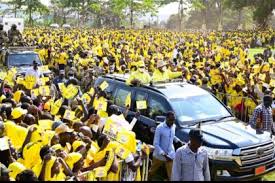
In a vibrant campaign rally on January 7, 2026, President Yoweri Museveni defended the legacy of the National Resistance Movement (NRM) as he sought to rally voters in Nakawa Division ahead of Uganda’s general elections. He emphasized the significant economic transformation the country has undergone under his leadership, particularly focusing on wealth creation through industrialization, manufacturing, and domestic production.
Addressing a packed crowd at Makerere University Business School, Museveni highlighted that Uganda has shifted from an import-dependent economy to one increasingly driven by local production, citing that 65% of products found in supermarkets today are locally made—compared to just 5% in the past. He declared that these changes reflect deep structural shifts in the economy and accused critics of being dishonest about the NRM’s contributions.
“Somebody told me yesterday that if you went to the supermarket today, you would find that 65 percent of the products are made here. In the past, 95 percent of the products in the supermarkets were imported,” he said, receiving cheers from the crowd.
He also mocked critics, saying, “Anybody who stands and says that NRM has done nothing will go to hell—Geyena in Luganda,” drawing laughs from the crowd.
Museveni placed particular emphasis on Uganda’s expanding industrial sector, showcasing the growth of industrial parks such as the Sino-Uganda Mbale Industrial Park, which houses 75 factories, and Namanve Industrial Park, Uganda’s largest, which has 273 factories employing over 24,000 people. These parks, he argued, are clear evidence of the NRM’s success in creating wealth and jobs.
He also discussed the critical role of manufacturing and artisanship in job creation, noting that the industrial parks provide thousands of jobs for Ugandans and contribute to the country’s economic growth. In addition, Museveni advocated for the integration of commercial agriculture as a core pillar of wealth creation, providing examples of successful agricultural businesses like Jeka Poultry Farm, which produces 2,500 trays of eggs daily and generates millions in revenue while creating hundreds of jobs.
Despite addressing some challenges, including corruption undermining government programs, Museveni pointed to the success of the Parish Development Model, which channels funds directly to communities to mitigate the issue of resource theft.
He further stressed that infrastructure alone is not enough for national prosperity, stating that wealth and job creation must go hand-in-hand with development efforts. He outlined that four key sectors—commercial agriculture, manufacturing, services, and ICT—are crucial for Uganda’s continued economic progress.
In his closing remarks, Museveni urged voters to elect leaders who prioritize wealth creation and responsible management of public funds, reminding them that they hold the power to shape the country’s future through their votes.
The rally was attended by the First Lady, Janet Kataaha Museveni, and other key NRM officials, all of whom urged voters to support President Museveni and NRM candidates in the upcoming elections.
With only a week remaining until Uganda’s general elections on January 15, Museveni’s message emphasized the need for unity, discipline, and a collective effort to continue Uganda’s transformation under the NRM government.