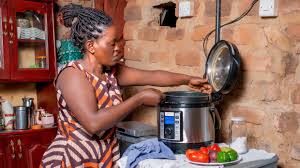
In many homes across East Africa, cooking has always meant charcoal, firewood, or gas. But today, two neighboring countries — Uganda and Kenya — are changing how families prepare their daily meals.
The shift is not just about stoves. It is about electricity, carbon markets, government policy, and how countries fund their clean energy transition.
Uganda’s electric cooking journey starts with a simple number: only about 2% of households currently cook with electricity. The government wants that number to rise to between 18% and 20% by 2030.
That is a very big jump.
Why is Uganda pushing so hard?
Over the past decade, Uganda invested heavily in large hydropower projects like the Karuma Dam and the Isimba Dam. These dams increased the country’s electricity generation capacity to over 1,000 megawatts.
But there was a problem.
Uganda had more electricity available than people were using. Power plants were ready, but many homes were not connected, and most families still cooked with charcoal or firewood.
Electric cooking became a solution. If more households cook with electricity, demand increases. More demand means better use of the power plants and better financial balance for the national electricity system.
In simple terms:
Every electric meal helps Uganda use the power it already produces.
Policies Designed to Change Habits
The Ugandan government did not stop at building dams. It introduced policies to encourage families to switch.
One major step was the introduction of the Fumba Tariff in 2021 by the Electricity Regulatory Authority. Under this system, electricity units used between the 81st and 150th unit per month are charged at a lower price (Shs412 per kWh). This pricing structure targets households that already use electricity for lighting and encourages them to start cooking with it.
The government also:
Reduced import duty on electric stoves from 25% to 10%
Removed taxes on parts used to assemble stoves locally
Maintained VAT waivers on LPG and ethanol
Supported energy-efficient appliances
Uganda also received financial support from the United Kingdom through UKAID. Funds are helping the Ministry of Energy develop standards, train technicians, and improve market coordination.
Pilot projects are distributing electric pressure cookers, starting with 1,000 units and aiming to scale up to 77,000 with support from the African Development Bank.
But challenges remain:
Electric appliances are still expensive for many families.
Electricity supply can be unreliable outside major towns.
Many households are used to cooking with charcoal and firewood.
Changing cooking habits is not just about price — it is about trust, culture, and convenience.
While Uganda focused on using its own electricity, Kenya built much of its clean cooking strategy around carbon markets.
Companies like KOKO Networks distributed ethanol stoves at subsidized prices. The business model depended heavily on selling carbon credits. These credits were bought by international companies looking to offset their emissions.
As long as carbon credit prices were strong, the model worked.
But the voluntary carbon market became unstable. Prices fell. Scrutiny increased. In 2026, KOKO Networks collapsed, showing how dependent the system was on global carbon revenue.
In response, Kenya introduced tighter oversight. The government operationalized the Kenya National Carbon Registry. This system:
Centralizes approval of carbon projects
Tracks issuance of credits
Links carbon sales to national climate reporting
Now, carbon credit projects must receive government approval, not just private certification. This adds credibility but also increases paperwork and approval time.
Two Countries, Two Funding Models
Uganda and Kenya are both trying to reduce charcoal use and promote cleaner cooking. But their funding models are different.
Uganda’s model depends mainly on:
Domestic electricity generation
Tariff incentives
Government and donor support
Kenya’s model has depended on:
Carbon credit revenue
Private clean cooking companies
International offset buyers
Each model has risks.
Uganda’s system depends on reliable rainfall for hydropower, stable tariffs, and strong grid performance.
Kenya’s system depends on international carbon markets, global demand for offsets, and regulatory approvals.
What Was Missing in the Story
What often goes unnoticed is how deeply cooking connects to national economics.
In Uganda, cooking with electricity helps:
Use excess power generation
Improve utility revenues
Support national infrastructure investments
In Kenya, clean cooking projects connect local kitchens to global climate finance. When a family uses ethanol instead of charcoal, it becomes part of international carbon accounting systems.
Another missing piece is behavior change.
Even with lower tariffs or subsidized stoves, families may hesitate to switch if:
They fear high electricity bills
They distrust new technologies
They lack stable incomes
They live in areas with frequent blackouts
Energy transition is not only about technology — it is about people’s daily routines.
The Dinner Table as Energy Policy
At first glance, cooking may seem like a simple household activity. But in East Africa, it is now part of national strategy.
Uganda is trying to raise electric cooking from 2% to nearly 20% in just a few years. Kenya is restructuring its carbon market to protect the integrity of clean cooking projects.
Both countries are learning that clean cooking is not just about stoves.
It is about:
How power plants are financed
How carbon credits are regulated
How governments design tariffs
How households respond to change
In the end, the success of these policies will not be measured in megawatts or carbon certificates.
It will be measured in ordinary kitchens —
in pots of boiling water,
in families choosing new ways to cook,
and in whether clean energy becomes part of everyday life across East Africa.