Pope Leo XIV arrived in Lebanon on Sunday, bringing a message of peace and unity to a country still struggling to recover from years of political turmoil, economic collapse, and the recent war between Israel and Hezbollah.
The visit marks the second stop of the pope’s first international tour since his election in May. He began the tour in Turkey, where he emphasized Christian unity and regional peace. Speaking to journalists during the flight to Beirut, Pope Leo said his trip carried “a special theme of being a messenger of peace, of wanting to promote peace throughout the region.”
Warm Welcome in a Hurting Nation
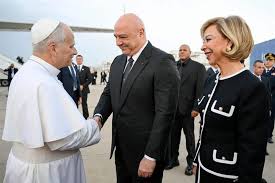
Lebanon rolled out an elaborate welcome for the pontiff. President Joseph Aoun — the only Christian head of state in the Arab world — led officials in receiving him at Beirut’s airport. The pope was greeted by children, a brass band, a red carpet reception, and a 21-gun salute, while ships in the port sounded their horns. Two Lebanese military aircraft escorted his plane as it descended.
Lebanese from different religious backgrounds lined the streets to welcome the pope. “I came to say that the Lebanese are one people and we are united,” said 19-year-old Zahra Nahleh from the war-ravaged south. “The pope is not just for Christians but for Muslims too, and we love him a lot. We want him to bless our land.”
Visit Comes at a Time of National Strain
Long seen as a symbol of coexistence, Lebanon has endured a series of devastating crises since 2019 — including an economic meltdown, the 2020 Beirut port explosion, and a brutal conflict between Israel and Hezbollah that largely ended with a ceasefire last November. Although hostilities officially ceased, Israel has continued periodic strikes on Lebanese territory, claiming to target Hezbollah positions.
The last papal visit to Lebanon was in 2012, when Benedict XVI came amid rising regional tensions. Pope Leo’s visit has therefore been highly anticipated, especially among Christians whose population has been shrinking due to emigration despite their key political role. In Lebanon’s power-sharing system, the presidency is reserved for a Maronite Christian.
High-Level Meetings and Symbolic Gestures
During his 48-hour stay, the pope is scheduled to meet President Aoun, Prime Minister Nawaf Salam, and Parliament Speaker Nabih Berri at the presidential palace. He will also address diplomats and government officials in a speech expected to focus on peacebuilding, reconciliation, and the protection of Lebanon’s diverse communities.
Despite the rain, traditional dancers performed at the palace entrance to welcome him. Youth scouting groups linked to Hezbollah also lined parts of the route in southern Beirut, where the militant group holds influence. Posters of the late Hezbollah leader Hassan Nasrallah were displayed near billboards welcoming the pope. A day earlier, Hezbollah called on Pope Leo to denounce Israeli “injustice and aggression” against Lebanon.
A Tour Rooted in Reconciliation
The Lebanese leg of Pope Leo’s trip follows a historic visit to Turkey, where he visited Iznik to mark the 1,700th anniversary of the First Council of Nicaea — a crucial moment in early Christian history. There, he participated in an ecumenical service with Patriarch Bartholomew I, head of the world’s 260 million Orthodox Christians.
In Istanbul, he celebrated mass with thousands of worshippers despite heavy rain. He also met with the grieving father of a 14-year-old Italian-Turkish boy who was fatally stabbed in February, offering comfort and prayers.
His visit to the Armenian Cathedral paid tribute to Turkey’s largest Christian community — acknowledging their resilience and faith through “tragic circumstances,” in what many saw as a delicate reference to the 1915–1916 massacres, recognized as genocide by numerous countries but not by Turkey.
A Journey of Peace
As Lebanon grapples with political uncertainty, economic hardship, and the lingering wounds of war, Pope Leo’s arrival has stirred hope among many who see his visit as a rare moment of unity.
For the pope, the journey is a test of his diplomatic style — quieter and more understated than that of his predecessor Francis — yet grounded in dialogue, healing, and a commitment to fostering peace in a deeply troubled region.