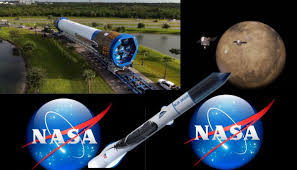
NASA is set to launch an exciting new mission to Mars on Sunday, November 9, 2025, aboard Blue Origin’s New Glenn rocket. The mission, named ESCAPADE (Escape and Plasma Acceleration and Dynamics Explorers), aims to answer one of the most intriguing questions about our neighboring Red Planet: How did Mars die?
The launch will mark New Glenn’s second flight since its debut earlier in January 2025, and it will be NASA’s first interplanetary mission aboard the rocket. This dual-satellite mission is designed to investigate how Mars lost its thick atmosphere and its ability to retain water, ultimately transforming from a once-habitable world to the dry, desolate planet we see today.
The two identical satellites, Blue and Gold, will work in tandem to study Mars from orbit, providing critical data on how the Sun’s solar wind strips away the Martian atmosphere.
Previous Mars missions have shown that the planet lacks a global magnetic field, but instead has patchy magnetic “bubbles” embedded in its crust. These bubbles offer some protection to Mars from the solar wind, but scientists are still unsure of the full dynamics at play.
What makes this mission so significant is that it will be the first time NASA sends a dual-satellite pair to another planet. Instead of using a single satellite, which has made it difficult to get a comprehensive view of how the solar wind interacts with Mars’ atmosphere, the ESCAPADE mission will provide the first simultaneous, 3D map of the process.
By observing Mars from multiple angles at the same time, ESCAPADE will allow scientists to see how solar particles energize the atmosphere and strip away its layers.
The dual satellites will work together to offer a detailed and accurate picture of the Martian environment. The goal is to study the interaction between Mars and the solar wind, which could give scientists deeper insights into why the planet lost its atmosphere — and whether it ever had conditions suitable for life.
Mars has long been a subject of fascination for scientists, especially given its potential to have once harbored liquid water on its surface.
The ESCAPADE mission could provide valuable clues about the history of Mars’ climate and atmosphere, and how it evolved into the barren world we see today.
NASA’s ESCAPADE mission is a part of the broader effort to understand planetary climates and atmospheres, offering vital clues not just about Mars, but also about other planets in our solar system and beyond.
This mission’s findings could also inform future human exploration of Mars, potentially paving the way for a better understanding of its past and its capacity to support life.
As the ESCAPADE mission prepares for its historic launch, astronomers and space enthusiasts alike are eager to see what new discoveries await, with hopes that the mission will bring us one step closer to answering the age-old question: How did Mars die?