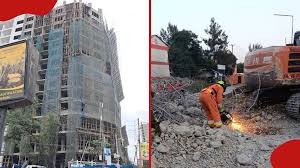
The recent collapse of a 16-storey building under construction in Nairobi’s South C estate has sparked alarm within Kenya’s construction sector, with experts warning that the incident is a symptom of a far deeper and more dangerous crisis facing the capital.
Building professionals now caution that up to 85 percent of high-rise buildings in Nairobi may be structurally unsafe, raising fears of widespread disaster should the city experience even a minor earthquake or ground tremor.
Days after the South C structure came down, engineers, architects and planners from leading professional bodies have demanded an urgent investigation, insisting the collapse was not an accident but the predictable result of ignored regulations, weak oversight and unchecked greed.
The professionals—drawn from the Institution of Engineers of Kenya (IEK), the Architectural Association of Kenya (AAK), the Architects Alliance (TAA), the Kenya Institute of Planners (KIP) and allied bodies—said serious questions must be answered about how additional floors were approved on a building that was never designed to support them.
According to the experts, responsibility begins with the developer but extends to every stage of the construction process, including design, supervision and approval by authorities. They cited inconsistencies between official records and what was happening on the ground, questioning who made key structural decisions and who signed off on changes to the original plans.
Lang’ata Member of Parliament Felix Odiwuor (Jalang’o), who addressed the press following the collapse, said accountability must be enforced to prevent similar tragedies in the future.
Beyond South C, the professionals warned that the incident exposes a national construction emergency. Data from a recent survey covering approximately 15,000 buildings in Nairobi shows that only 15 percent are considered safe for human occupation, leaving the vast majority potentially dangerous.
“This means millions of residents are at risk,” the experts said, warning that even a low-magnitude earthquake could cause catastrophic building failures across the city.
George Ndede, president of the Architectural Association of Kenya, warned:
“If a tremor, even of a low Richter scale, were to happen in Kenya today, many buildings would come down.”
The experts also highlighted visible warning signs that are often ignored, including buildings that require artificial lighting during the day due to poor design, faulty drainage systems, overcrowded developments and persistent sewer problems. These, they said, are red flags of deeper structural and planning failures.
“If you have to switch on lights in your house during the day, that is a problem. If the sewer system in your area is always stinking, that is also a problem,” they cautioned.
The debate has intensified after Lands Cabinet Secretary Alice Wahome publicly blamed the Nairobi County Government for approving additional floors on the South C building despite structural concerns. She said preliminary findings had already established what went wrong and confirmed that a report by the National Construction Authority (NCA) would name county officials involved in approving the project.
In a related move, the Office of the Director of Public Prosecutions (ODPP) directed Inspector General of Police Douglas Kanja to immediately launch investigations into the circumstances surrounding the collapse.
As pressure mounts on regulators, professionals are calling for public accountability, stricter enforcement of building codes and the blacklisting of rogue contractors, warning that without urgent reforms, Nairobi risks a far deadlier disaster in the future.