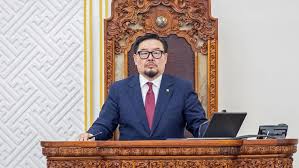
Gombojav Zandanshatar has stepped down from office after months of mounting political instability, marking a new chapter of uncertainty for Mongolia.
In a voluntary resignation announced before parliament, Zandanshatar described the moment as a “challenging time,” citing both domestic political tensions and broader global pressures. His departure comes less than a year after taking office, underscoring the fragile state of the country’s leadership.
The political crisis has been fueled by a boycott from the Democratic Party of Mongolia, whose lawmakers have refused to attend parliamentary sessions in protest against Uchral Nyam-Osor.
The opposition has accused Uchral of corruption and objected to his dual influence within both the ruling party and the legislature, effectively stalling parliamentary business.
Within the ruling Mongolian People’s Party (MPP), internal divisions have also deepened the crisis. The party is reportedly split between factions aligned with Ukhnaa Khurelsukh and former prime minister Luvsannamsrain Oyun-Erdene, further complicating efforts to maintain unity and governance.
Zandanshatar, who had previously survived an attempt to remove him from office, said his decision to step aside was intended to prioritise national stability over personal or political interests. He also warned of rising global economic pressures, including increasing oil prices that could drive up the cost of living.
With the resignation now formalised, parliament has 30 days to appoint a new prime minister. The MPP is expected to nominate a successor at an upcoming party congress, though no date has been confirmed.
As Mongolia navigates this leadership transition, the combination of political infighting, opposition resistance, and economic uncertainty leaves the country at a critical crossroads.