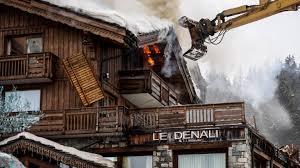
Hundreds of tourists in the French Alps and more than a thousand residents in southern Italy were forced to flee their homes and hotels this week as separate disasters—a major hotel fire and a massive landslide—highlighted the growing risks posed by structural vulnerability and extreme weather across Europe.
Fire Ravages Luxury Hotel in French Alps
A large fire swept through the five-star Hôtel des Grandes Alpes in the exclusive ski resort of Courchevel, France, on Tuesday evening, forcing the evacuation of hundreds of guests and staff.
The blaze broke out at around 7 p.m. in the attic of the luxury hotel, where rooms can cost up to £11,000 per night. Local authorities said the fire quickly spread beneath the roof, making it extremely difficult for firefighters to bring under control. By Wednesday morning, the fire was still burning, with officials describing the response as a “complex operation.”
Initial reports confirmed the evacuation of nearly 100 people, but local media later said the number rose to approximately 270 as flames spread to a nearby building. As a precaution, guests at the neighboring five-star Lana Hotel were also evacuated.
Authorities confirmed that no injuries were reported, and the evacuation proceeded calmly. Guests and staff were temporarily relocated to other hotels within the resort and to a nearby municipal hall.
Dramatic footage from the scene showed firefighters battling the inferno as flames tore through the wooden structure and thick black smoke poured into the night sky. Images later revealed extensive damage to the hotel’s roof.
Bruno Charlot, sub-prefect of Albertville, explained that firefighting efforts were severely hampered by the building’s roof construction.
“It is very difficult to reach the flames that are running under a roof made of slate and sheet metal,” Charlot said. “Firefighters must remove the stones and cut through the sheets before accessing the fire. A thick layer of snow on the roof only makes matters worse.”
Investigators are expected to determine the cause of the fire once the site is secured.
Sicily Landslide Displaces 1,500 Residents
Meanwhile, in southern Italy, a massive landslide triggered by days of heavy rainfall has forced the evacuation of more than 1,500 people in the town of Niscemi, Sicily.
The landslide, which stretched across roughly four kilometers (2.5 miles), caused homes, vehicles, and infrastructure to slide as much as 20 meters downhill. Civil protection authorities established a 150-meter-wide no-go zone, warning that the ground remains dangerously unstable.
Italian Prime Minister Giorgia Meloni visited the area on Wednesday as officials confirmed that many residents will not be able to return to their homes.
“There are houses on the edge of the landslide that can no longer be inhabited,” said Fabio Ciciliano, head of Italy’s civil protection agency. “We must work with the mayor to find permanent relocation solutions for these families.”
Experts say the disaster was worsened by the town’s geological makeup. Niscemi is built on layers of sand and clay, materials that become highly unstable when saturated with water. The town has suffered similar disasters before, including a major landslide in 1997 that displaced hundreds.
The Italian government has declared a state of emergency, allocating an initial €100 million in aid. However, regional officials estimate that total damages could reach €2 billion. The disaster has reignited political debate over construction practices in high-risk zones.
A Broader Warning
Though unrelated, both incidents underscore the vulnerability of buildings and communities exposed to environmental and structural risks—whether in high-altitude tourist resorts or long-established towns facing increasingly extreme weather conditions.
Authorities in both France and Italy continue to monitor conditions closely as recovery and investigations move forward.