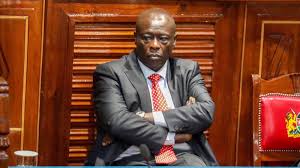
The Supreme Court has dismissed applications filed by former Deputy President Rigathi Gachagua and the National Assembly in a long-running legal battle over Gachagua’s impeachment. The decision clears the way for the court to hear the main appeal on whether the High Court bench that handled the case was lawfully constituted.
In a ruling delivered on Friday, a five-judge bench led by Chief Justice Martha Koome rejected the applications from both sides and ordered that each party bear its own costs.
The case dates back to October 2024, when the National Assembly impeached Gachagua. After his removal from office, several petitions were filed in different High Courts challenging the impeachment process. These petitions raised serious constitutional questions, prompting the matter to be referred to the Chief Justice to appoint special benches to hear the cases.
On October 14, 2024, Chief Justice Martha Koome appointed a three-judge bench made up of Justices Eric Ogola, Anthony Mrima, and Frida Mugambi to hear the first group of petitions. As more petitions were filed, including attempts to stop Senate proceedings and block the swearing-in of Prof. Kithure Kindiki as Deputy President, Deputy Chief Justice Philomena Mwilu appointed the same bench in the absence of the Chief Justice.
This second appointment became the centre of the dispute. Gachagua challenged the Deputy Chief Justice’s authority to appoint the bench and asked that the three judges step aside, claiming bias and conflict of interest. The High Court dismissed both requests, ruling that appointing judges is an administrative duty that the Deputy Chief Justice can perform when the Chief Justice is away, and that there was no evidence to justify the judges’ recusal.
However, the Court of Appeal later overturned the High Court’s decision on the issue of appointment. It ruled that only the Chief Justice has the power to empanel High Court benches, except in clearly defined exceptional circumstances. The appellate court, however, agreed with the High Court that there was no basis to remove the judges for bias.
Following this ruling, the National Assembly appealed to the Supreme Court, arguing that the Court of Appeal had wrongly interpreted the law. Gachagua also filed a cross-appeal. Before the main appeal could be heard, Gachagua applied for several interim orders, including stopping High Court proceedings, striking out the National Assembly’s appeal, and removing certain documents from the court record. The National Assembly, on its part, asked the Supreme Court to strike out Gachagua’s cross-appeal.
The Supreme Court dismissed all these applications. The judges ruled that the court does not have the power to stop ongoing High Court proceedings at this stage. They also found that the National Assembly’s appeal raises serious legal questions that must be heard fully. The court declined to remove the disputed documents, noting that they are central to the case and were already relied on by both the High Court and the Court of Appeal.
The court further ruled that Gachagua’s cross-appeal did not meet the high threshold required for summary dismissal. It also rejected the National Assembly’s attempt to strike out the cross-appeal, stating that issues such as alleged judicial bias and the right to a fair hearing fall within the Supreme Court’s constitutional mandate.
In its decision, the court emphasized that the dispute before it revolves around the Deputy Chief Justice’s directions of October 18, 2024, appointing the High Court bench. With the dismissal of the applications, the Supreme Court will now proceed to hear the main appeal on whether that appointment was lawful.
The judges clarified that their review is strictly limited to the legality of the High Court bench’s appointment and does not determine whether Gachagua’s impeachment itself was lawful. The substantive questions about the impeachment process remain before the High Court.