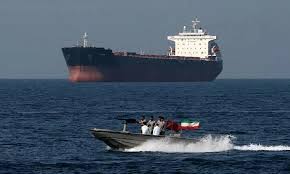
Iran’s Revolutionary Guards have seized a foreign vessel carrying what they say was smuggled fuel, in the latest operation targeting illegal shipments in one of the world’s most strategically important waterways.
State media reported on Sunday that the ship, operating under the flag of Eswatini, was intercepted while transporting 350,000 litres of smuggled fuel. The vessel was subsequently escorted to the port of Bushehr in southwestern Iran.
According to a local Revolutionary Guards commander quoted on state television, the ship had 13 crew members, all of whom are nationals of a neighbouring country and India. No further details were provided about the exact origin of the crew.
Iranian forces regularly detain tankers accused of smuggling fuel in the Strait of Hormuz, a narrow but vital shipping corridor through which a significant portion of the world’s oil and liquefied natural gas passes.
These operations, though presented by Iran as anti-smuggling efforts, frequently raise international concerns due to the already tense security climate in Gulf waters.
Earlier this month, the Revolutionary Guards seized a Marshall Islands-flagged oil tanker travelling through the Gulf.
The ship’s management company later confirmed that the vessel and its 21 crew members had been released.
Iranian news agency Fars reported that the Marshall Islands-flagged vessel, named Talara, had abruptly diverted into Iranian waters while passing the Strait of Hormuz. Its cargo — Iranian petrochemical products — was allegedly being transported illegally toward Singapore.
Fars added that the operation targeted an Iranian individual or company suspected of orchestrating the shipment.
Last year, the Guards seized a container ship they said was linked to Israel, following an attack on Iran’s consulate in Syria that Tehran blamed on Israel.
However, Fars emphasized that the seizure of the Talara was not a retaliation against any state, but “a purely local matter” focused on illegal trade.
The repeated seizures underscore the ongoing friction in the Gulf, where Iran’s maritime operations intersect with global shipping routes and geopolitical rivalries.
While Tehran frames these interventions as law-enforcement actions, Western governments have often accused Iran of using tanker seizures for political leverage.
The fate of the Eswatini-flagged vessel and its crew is yet to be clarified as Iranian authorities continue their investigation.