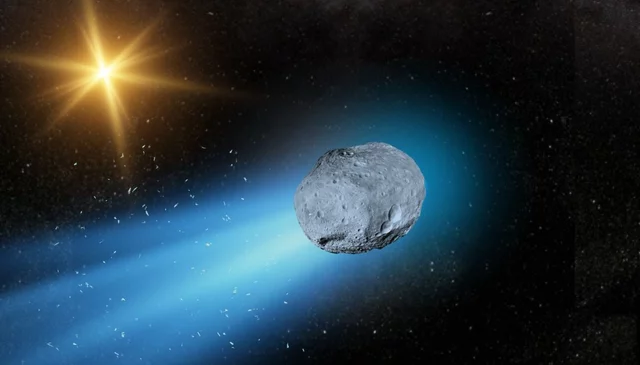
Astronomers around the world are turning their eyes to the sky as the mysterious interstellar comet 3I/ATLAS reaches its closest point to the Sun today — a moment that promises to deepen humanity’s understanding of how material travels between distant stars.
NASA has confirmed that 3I/ATLAS, only the third known interstellar object ever detected passing through our solar system, will make its perihelion — or closest approach to the Sun — between October 29 and 30, 2025, at a safe distance of about 1.8 astronomical units, or roughly 270 million kilometers from the Sun.
Discovered on July 1, 2025, by the ATLAS telescope in Chile, the comet was first observed traveling toward the inner solar system from an unknown point in interstellar space. Unlike ordinary comets bound by the Sun’s gravity, 3I/ATLAS follows a hyperbolic trajectory, meaning it will pass through once — and never return.
“This is a truly rare opportunity,” said Professor Darryl Seligman, an astrophysicist at Michigan State University. “Each interstellar object offers us a snapshot of the chemistry and structure of other planetary systems, far beyond our Sun’s reach.”
After today’s solar encounter, scientists expect 3I/ATLAS to accelerate out of the solar system at 60 kilometers per second, crossing Mars’ orbit before disappearing into deep space.
The comet’s interstellar origin has sparked online fascination — and a fair share of conspiracy theories. Some enthusiasts, citing comments by Professor Avi Loeb of Harvard University, speculated that the object might be of artificial or extraterrestrial origin.
Loeb himself later clarified that while 3I/ATLAS could theoretically perform an Oberth maneuver — a slingshot-like acceleration near a star — there is no evidence that it is anything but a natural body.
“The Sun’s energy will heat its surface intensely, but there’s nothing to suggest this comet is artificial,” Loeb said. “It remains a natural interstellar traveler.”
Other astronomers, including Professor David Jewitt of UCLA, have dismissed such claims, emphasizing that its composition and trajectory are consistent with naturally occurring cometary material.
NASA’s Jet Propulsion Laboratory (JPL) and the European Space Agency (ESA) have assured the public that the comet poses no threat to Earth or the Sun. Instead, the focus remains on the wealth of data scientists hope to collect from the event.
“We’re using multiple observatories to study how 3I/ATLAS reacts to solar radiation,” said Dr. Karen Becker, a NASA planetary scientist. “Its behavior could reveal how interstellar ices and dust survive — or evaporate — when exposed to a new star’s heat.”
The data gathered could offer new insights into planet formation, the distribution of organic molecules, and even the origins of life in the cosmos.
This marks only the third time an interstellar object has been observed traversing our solar system — following the discovery of 1I/‘Oumuamua in 2017 and 2I/Borisov in 2019.
While ‘Oumuamua’ baffled scientists with its cigar-like shape and odd acceleration, 3I/ATLAS appears to be a more traditional, icy comet — giving researchers a more familiar subject to study.
“This event reminds us that our solar system isn’t isolated,” said Prof. Seligman. “It’s part of a much larger galactic ecosystem where stars, planets, and comets continually exchange material.”
As 3I/ATLAS glides past the Sun and vanishes into the darkness beyond, astronomers will continue tracking its journey — a fleeting visitor from the stars, carrying secrets of distant worlds we may never see.