When flames rise in Tanzania, the smoke does not stop at her borders — it drifts across East Africa. The recent post-election violence in Tanzania has left dozens dead and hundreds injured, sparking concern among neighboring nations and regional observers who fear that unrest in one country could destabilize the entire region.
The October 2025 general election — meant to strengthen Tanzania’s democracy — has instead plunged the country into turmoil. Protests erupted after two leading opposition candidates were barred from participating, a move that many citizens and international observers described as undemocratic.
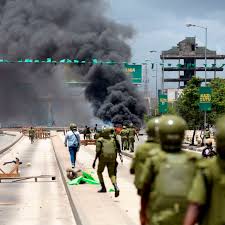
Demonstrations have been particularly fierce in border towns like Namanga, where Kenyans and Tanzanians share trade and family ties. Witnesses described scenes of chaos as police fired tear gas and live bullets at protesters demanding a rerun of the election.
“We have never seen such anger here. The people feel their voices have been silenced,” said a resident of Arusha who fled to safety near the Kenyan border.
The Namanga One-Stop Border Post, a symbol of East African integration, has now become a grim reminder of the cost of political instability — with demonstrators seen carrying the bodies of those killed in clashes.
Tanzania’s unrest is more than a domestic issue; it is a regional concern. The East African Community (EAC), which includes Kenya, Uganda, Rwanda, Burundi, South Sudan, the DRC, and Tanzania, depends on peace and open trade routes to thrive.
If Tanzania — one of the region’s most stable economies — continues to burn, the ripple effects could cripple cross-border trade, tourism, and regional projects like the East African Railway and energy corridors.
“Integration cannot thrive on ashes. Peace in Tanzania is peace for East Africa,” said a political analyst in Kampala. “The region must not remain silent.”
East Africa has made huge strides toward economic and political integration, but unity cannot survive where democracy fails. Regional leaders are being urged to intervene through diplomacy, not indifference.
Kenya, Uganda, and Rwanda have all expressed concern and offered to support dialogue between Tanzania’s ruling party and opposition groups. The African Union (AU) and EAC Secretariat have also called for restraint, urging the Tanzanian government to protect human rights and reopen space for peaceful political expression.
“This is not the time for silence. It is the time for leadership,” one AU official told journalists in Nairobi.
Behind the headlines are ordinary Tanzanians — traders, farmers, and families — whose lives have been torn apart.
Markets remain closed, schools suspended, and transport paralyzed in parts of Arusha, Dodoma, and Dar es Salaam.
The United Nations Human Rights Office estimates that at least 40 people have died and over 300 have been arrested since the protests began. Hospitals in northern Tanzania report being overwhelmed by casualties.
The crisis in Tanzania serves as a warning to the rest of East Africa: democracy cannot be taken for granted. Political exclusion, corruption, and lack of accountability can easily undo years of progress.
If Tanzania burns, East Africa bleeds. The region must act — through diplomacy, mediation, and honest leadership — before the flames spread beyond control.
Peace in Tanzania is not just a national concern; it is a regional lifeline. The East African dream of unity, prosperity, and integration depends on stability within each member state. The time for silence is over — it is time for action, unity, and dialogue.