A senior Hamas leader has firmly rejected calls for the group to give up its weapons or accept foreign control in Gaza, challenging key demands by the United States and Israel as the fragile ceasefire continues.
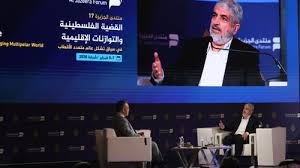
Speaking at a conference in Doha, Qatar, on Sunday, Khaled Mashal, Hamas’s foreign affairs chief and former political leader, said the Palestinian Islamist group would not surrender its arms. He described armed resistance as a legitimate response to what Hamas views as Israel’s occupation of Palestinian land.
“As long as there is occupation, there is resistance,” Mashal said. “Resistance is a right of people living under occupation, and it is something nations take pride in.”
Ceasefire terms under strain
The comments come as a US-brokered ceasefire in Gaza enters its second phase. This phase is meant to include the demilitarisation of Gaza, the disarmament of Hamas, and a gradual withdrawal of Israeli forces from the territory.
Hamas has repeatedly said that disarmament is a red line, although it has suggested it might consider transferring its weapons to a future Palestinian-led governing authority, rather than surrendering them to foreign powers.
Israeli officials claim Hamas still has about 20,000 fighters and roughly 60,000 assault rifles inside Gaza, despite months of intense fighting.
Governance and foreign involvement
A Palestinian technocratic committee has recently been formed to manage the day-to-day administration of Gaza after the war. However, it is still unclear whether the committee will have authority over security matters or the issue of disarmament.
The committee operates under the “Board of Peace,” an initiative launched by US President Donald Trump. The board was first designed to oversee the Gaza ceasefire and post-war reconstruction but has since expanded its role, raising concerns among critics that it could weaken the influence of the United Nations.
Trump unveiled the Board of Peace at the World Economic Forum in Davos last month, where leaders from nearly two dozen countries signed its founding charter. He also created a Gaza Executive Board, an advisory group that includes US envoys Steve Witkoff and Jared Kushner, as well as former British prime minister Tony Blair.
Hamas warns against foreign rule
Mashal urged the Board of Peace to take what he called a “balanced approach” that would allow reconstruction and humanitarian aid to reach Gaza’s 2.2 million residents. However, he warned that Hamas would strongly oppose any form of foreign administration.
“Palestinians must govern Palestinians,” he said. “Gaza belongs to its people and to Palestine. We will not accept foreign rule or external guardianship.”
Uncertain path ahead
Mashal’s remarks highlight the growing tension between international plans for Gaza’s future and Hamas’s refusal to disarm. With reconstruction, governance, and security all unresolved, the statements raise fresh doubts about whether the ceasefire can hold and how Gaza will be governed once the war ends.