In many Ugandan communities, marriage has long been anchored in tradition, with the payment of bride price serving as a symbolic gesture that unites families. However, as society modernizes, the practice is increasingly being questioned for turning what was once a cultural ritual into what some see as a commercial transaction.
Across Uganda, bride price remains a deeply embedded cultural expectation. Traditionally, a man formally visits his partner’s family and presents gifts as appreciation for raising their daughter. Without fulfilling this custom, many communities do not recognize a union as legitimate—even in cases of death.
One widely publicized example involved a man named Laban Sabiti, who was left to care for five children after his father-in-law took back his daughter because Sabiti had delayed paying a bride price of six million Ugandan shillings. In another case, a husband was reportedly denied the right to bury his deceased wife until the outstanding bride price was paid.
The Changing Face of Kwanjula
Among the Baganda people, the traditional marriage introduction ceremony—known as kwanjula—was historically modest. The ceremony primarily served as a meeting between two families to establish relationships and confirm the union.
According to Spire Ssentongo, an academic at Makerere University, the ceremony was never intended to represent a payment for the bride.
“At that point, the family of the man was essentially being ‘born’ into the woman’s family,” Ssentongo explained. “It was about creating relationships and building familiarity between the two families.”
The items exchanged during the ceremony were largely symbolic, reflecting goodwill rather than wealth.
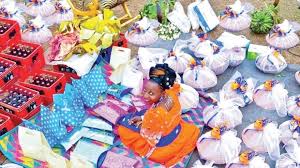
However, modern influences and social competition have significantly altered the practice. Today, some ceremonies involve extravagant displays of wealth, with grooms arriving with large convoys of gifts, livestock, and luxury vehicles. In some cases, event planners reportedly stage elaborate scenes—borrowing cars, livestock, or even using prop money—to create the appearance of affluence.
Social Pressure and Rising Costs
These growing expectations have created financial pressure on many young couples. Instead of marrying early, some partners choose to cohabit while waiting to accumulate the resources needed for elaborate ceremonies. Others postpone marriage indefinitely.
Ironically, such displays often mask financial hardship. Many families invest heavily in ceremonies only to struggle financially afterward.
Ssentongo also pointed out that kwanjula itself traditionally served as the marriage ceremony. Today, however, multiple events—such as okukyala, an initial visit meant to introduce marriage intentions—have evolved into costly functions of their own.
“People arrive with bags of sugar, soap, cooking oil, and many other items,” he said. “Yet originally it was simply meant to set a date for the kwanjula.”
The Meaning Behind Bride Price
For cultural custodians, bride price still holds symbolic value. Yusuf Ahmed Lumu, secretary of the association of Aboogezi b’Emikolo (traditional ceremony spokespersons) in Buganda, argues that the practice was never intended to equate to buying a woman.
“Bride price is a gesture of gratitude to the parents for raising and caring for their daughter,” Lumu explained.
However, he acknowledged that the custom has increasingly become commercialized, sometimes giving the impression that daughters are being “sold” through negotiations and costly demands.
Traditionally, the value of bride price varied widely depending on the region and the groom’s ability to provide. In some areas it could be symbolic items such as fish, stones, or even white ants, reflecting local customs rather than monetary wealth.
Today, however, requests can include anything from religious texts to cars, land titles, water tanks, or building materials—items critics say have little connection to the original cultural meaning.
Culture Versus Change
The debate over bride price has sparked public discussion, including on social media platforms like X (Twitter). While some people argue that questioning the practice undermines African culture, others believe cultural traditions must evolve to reflect modern realities.
Ssentongo maintains that culture should ultimately serve the people who practice it.
“If cultural evolution helps reduce oppression of women, girls, or even men, then it should be seen as a productive development,” he said.
Preserving Tradition Without Excess
Traditional leaders like Lumu emphasize that many of today’s excesses are not part of authentic Buganda culture. Practices such as inviting more guests than agreed upon, throwing money during ceremonies—a custom borrowed from foreign weddings—or extravagant displays of wealth can undermine the ceremony’s cultural meaning.
In the past, marriage ceremonies were modest gatherings involving only a few family representatives and symbolic gifts.
Today, however, social competition and modern influences have transformed them into large public events that sometimes overshadow the values they were meant to represent.
As Uganda’s society continues to evolve, the challenge remains balancing respect for tradition with the need to prevent cultural practices from becoming burdensome or exploitative.