A 64-year-old woman in New South Wales, Australia, suffered for nearly a year with worsening symptoms before doctors discovered that a rare parasite — never before recorded in humans — had been living unseen inside her body.
Mysterious Illness
The woman was first admitted to hospital after experiencing three weeks of abdominal pain and diarrhea. She also had a dry cough and night sweats.
Scans showed inflammation in her lungs and lesions in her liver and spleen. Blood tests revealed high levels of eosinophils, white blood cells that often increase during parasitic infections.
Doctors diagnosed her with eosinophilic pneumonia and treated her with steroids. Although some symptoms improved, the underlying cause remained hidden. Tests for bacteria, fungi and common parasites all came back negative.
Symptoms Continue Without Explanation
Months passed, but her condition did not improve. Even after treatment with ivermectin — a drug used to fight parasitic worms — the infection persisted.
The parasite continued moving through her organs without being detected, silently causing damage to her lungs and other tissues.
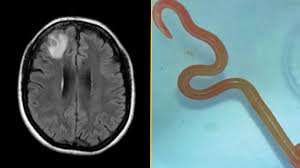
Nearly a year later, the woman began experiencing depression and memory problems. An MRI scan revealed a lesion in the right frontal lobe of her brain.
Shocking Discovery Inside the Brain
During surgery to examine the brain lesion, doctors made a startling discovery: a live, bright-red worm about 8 centimeters (3 inches) long was inside her brain.
The parasite was identified as a third-stage larva of Ophidascaris robertsi, a nematode normally found in carpet pythons (Morelia spilota) in Australia. Until this case, it had never been seen infecting a human.
How It Likely Entered Her Body
Experts believe the woman accidentally swallowed parasite eggs while collecting wild leafy greens near her home, where carpet pythons are common. The eggs likely contaminated plants through snake droppings.
After entering her body, the larvae hatched and migrated through her organs — lungs, liver and eventually the brain — remaining hidden from standard tests for months.
Treatment and Recovery
Surgeons removed the worm and treated her with a combination of albendazole and ivermectin, along with corticosteroids to reduce inflammation.
Six months after surgery, the lesions in her lungs and liver had cleared, her blood results returned to normal, and her memory and mood improved significantly.
A Rare and Unprecedented Case
This is the first documented case of Ophidascaris robertsi infecting a human and the first time its larval form has been found living undetected in the human brain.
Doctors say the case highlights how rare parasites can remain hidden inside the body for long periods, causing damage before being discovered.