The race for sporting supremacy in East Africa is no longer being won under the bright lights of capital cities. Instead, it is unfolding in once-overlooked regional towns—at least for Uganda and Tanzania. As preparations for the 2027 Africa Cup of Nations (AFCON) gather pace, Kenya finds itself confronting an uncomfortable truth: while its neighbours are decentralising sports development, it has remained stubbornly Nairobi-centric.
Uganda’s unveiling of two state-of-the-art stadiums—the 20,000-seat Hoima City Stadium in the west and the 20,000-seat Akii Bua Stadium in Lira, northern Uganda—has sent a powerful message across the region. Built at a combined cost exceeding Ksh32 billion, the facilities were constructed by international firms, Turkey’s Summa International Construction Company Inc and Egypt’s SAMCO National Construction Company, respectively.
For regional observers, the symbolism is striking. Hoima and Lira, both considered “lesser cities” when compared to Kenya’s major urban centres, now boast infrastructure that outclasses anything currently available in Mombasa, Kisumu, Nakuru, or Eldoret.
A regional shift away from capital cities
Uganda’s approach mirrors a broader regional trend. Tanzania, the third co-host of AFCON 2027, is constructing the 30,000-seat Samia Suluhu Hassan Stadium in Arusha at a cost of Ksh14.4 billion, under China Railway Construction Engineering Group (CRCEG). The project ensures that the tournament will be felt across the country, not just in Dar es Salaam.
Uganda will similarly host AFCON matches in both Kampala and Hoima, effectively taking continental football into its rural heartlands and spreading the economic and social benefits nationwide.
Kenya, however, stands apart—and not in a good way.
Kenya’s unbalanced infrastructure reality
Kenya is the only one of the three AFCON hosts that has failed to meaningfully distribute its sports infrastructure beyond the capital. As things stand, Nairobi is the only city capable of hosting AFCON matches.
This imbalance has drawn sharp criticism from analysts and fans alike, who argue that Kenya has squandered a golden opportunity to uplift regional economies. Cities such as Kisumu, a historic cradle of Kenyan football talent, and Eldoret, the undisputed home of the world’s finest marathon runners, remain without stadiums that meet FIFA standards.
Even Mombasa—the country’s coastal gateway and tourism hub—lacks a modern facility capable of hosting major international matches.
Meanwhile, projects like the Jomo Kenyatta “International” Stadium in Mamboleo, Kisumu, have been derided as substandard, with critics accusing the government of branding modest county grounds as “international stadiums” without meeting global benchmarks.
The Talanta Sports City controversy
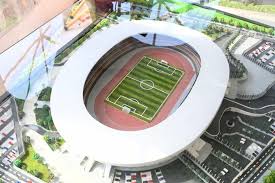
The controversy deepens with the decision to construct the Ksh44.7 billion, 60,000-seat Talanta Sports City, now renamed the Raila Odinga Stadium, in Nairobi. Built by the China Road and Bridge Corporation (CRBC), the project has become a lightning rod for criticism.
Analysts argue that Nairobi already had Nyayo National Stadium and Kasarani Stadium, both of which could have been upgraded—much like Rwanda’s widely praised renovation of the Amahoro Stadium in Kigali. Instead, Kenya opted to pour billions into yet another capital-based facility.
Many believe Talanta should have been built in Mombasa, Kisumu, Nakuru, or Eldoret, where it could have transformed local economies and unlocked dormant sports tourism potential.
The contrast is stark: Hoima, a town comparable in size and stature to Bungoma, will host AFCON matches, while Mombasa, one of East Africa’s most prominent cities, will watch from the sidelines.
Cities left behind
Nowhere is Kenya’s neglect more evident than in its coastal and lakeside regions. While Uganda is turning cities like Lira into emerging sports tourism destinations, Kenya’s talent-rich regions continue waiting for a “trickle-down” effect that has yet to materialise.
As the countdown to AFCON 2027 continues, the picture is becoming clearer. Uganda and Tanzania are preparing to showcase a vibrant, multi-city continental tournament, spreading opportunity, pride, and economic growth far beyond their capitals.
Kenya, by contrast, risks presenting the world with a “Nairobi-only” AFCON—a narrow vision that leaves much of the country watching from the margins.
By the time the first whistle blows in 2027, Kenya may find that while it was busy building in one city, its neighbours had already crossed the finish line.