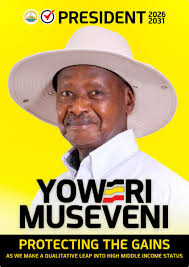
President Yoweri Kaguta Museveni is widely expected to win Uganda’s next general election with an overwhelming majority, with political analysts and ruling party strategists projecting support levels of around 80 percent, based on current political, economic, and electoral trends.
Although official results can only be announced by the Electoral Commission after voting, several key indicators suggest the National Resistance Movement (NRM) remains firmly in control of Uganda’s political landscape.
Strong Historical Performance
President Museveni has won every presidential election since 1996 with large margins. In the 2021 general election, he secured 58.6% of the vote, despite a highly competitive race and a youthful opposition wave. Analysts note that opposition fragmentation since then has strengthened the ruling party’s position.
Nationwide NRM Structures
The NRM maintains the largest grassroots political network in the country, with structures in all villages, parishes, sub-counties, and districts. Political scientists say this gives the ruling party a major advantage in voter mobilisation, especially in rural areas, where more than 70% of Ugandans live.
Government Programs Boosting Support
Supporters point to government programmes such as the Parish Development Model (PDM), Emyooga, youth funds, and agricultural financing, which have directly reached millions of households. According to Ministry of Finance data, over 10 million Ugandans have benefited from livelihood-focused interventions since 2021.
These programmes have strengthened Museveni’s appeal among farmers, women, youth groups, and informal workers.
Weak and Divided Opposition
Political analysts observe that the opposition remains divided, with no single candidate commanding nationwide support. Internal disagreements, lack of unified leadership, and limited grassroots presence have reduced their competitiveness compared to previous elections.
“This is not a one-on-one race,” said a Kampala-based political analyst. “The opposition vote is split, while the NRM vote is consolidated.”
Security, Stability, and Regional Leadership
Museveni continues to be credited by supporters for maintaining national stability, regional security, and Uganda’s role in peacekeeping across East and Central Africa. Surveys conducted by local research institutions consistently show that stability remains a top voter priority.
Public Opinion Trends
Recent internal party surveys and independent political assessments indicate rising approval ratings for the President, particularly in rural regions, northern Uganda, and parts of eastern Uganda. Analysts say this momentum, if sustained, could translate into a landslide victory approaching 80 percent.
Final Outcome Still with Voters
Observers stress that while projections strongly favor President Museveni, the final decision rests with Ugandan voters on election day and must follow constitutional and electoral processes.
“The numbers suggest a dominant NRM victory,” said one analyst, “but democracy requires patience, transparency, and respect for the ballot.”
Uganda is expected to hold its next general elections in January 2026, with President Museveni seeking another term.