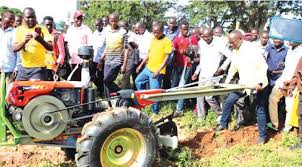
Uganda Urged to Harness Technology to Transform Agriculture and Empower Youth
Experts have urged Uganda to accelerate the adoption of technology in agriculture in order to modernize the sector, attract young people, and unlock new economic opportunities.
The call was made by Ashard Rab, Chief Executive Officer of the European Organisation for Sustainable Development and chairman of the International Sustainability Council, during the second edition of the RISE 4 Uganda Summit 2026 organized by the Uganda Development Bank (UDB).
The summit brought together government officials, industry leaders, and development partners to discuss strategies aimed at expanding Uganda’s economy from about $50 billion to $500 billion by 2040. Key sectors identified for growth include agro-industrialization, tourism, mineral development, and science and technology.
Rab emphasized that modern technology—including artificial intelligence—can transform agriculture from a sector often associated with poverty into a dynamic engine of economic growth. He pointed to the potential of platforms such as Sera AI, a system developed under the RISE initiative, which can analyze opportunities across the entire agricultural value chain.
According to Rab, integrating advanced technologies would improve productivity by guiding farmers with data-driven insights on inputs, production, logistics, and export markets. This approach would allow agriculture to become climate-smart, competitive, and capable of generating higher incomes for farmers while creating new opportunities for young people.
He encouraged policymakers to envision a new future for agriculture in which farmers operate technologically advanced farms, using tools such as digital tablets and drones to monitor production and manage resources efficiently.
“Agriculture should no longer be viewed as a sector of struggle,” Rab said, explaining that with proper tools, knowledge, and investment, farms could become centers of innovation and profitable enterprises.
Balancing Technology and Employment
However, industry leaders also cautioned that technological transformation must be balanced with employment needs.
Aga Sekalala, Chief Executive Officer of Ugachick Poultry Breeders Limited and chairman of the Uganda Manufacturers Association, noted that while advanced technology can boost productivity, Uganda must ensure that its large youthful population remains actively employed in the sector.
He warned that one of the biggest challenges facing Uganda’s agricultural industry is post-harvest losses. Estimates suggest that between 30 and 45 percent of agricultural produce is lost after harvest, with grain losses reaching as high as 80 percent in some cases.
Such losses, Sekalala said, highlight the urgent need for investment in storage facilities, cold-chain systems, and improved processing infrastructure.
He cited successful examples from other African countries. In Nigeria, solar-powered cold storage units known as “cold pumps” allow farmers to store produce at markets for a small fee, helping reduce food waste while creating jobs. Similarly, in Kenya, companies such as InspiraFarms have introduced modular solar-powered cold storage units near farms, enabling farmers to extend the shelf life of vegetables and transport produce to markets more efficiently.
Experts believe Uganda could adopt similar systems by establishing collection centers that aggregate produce such as milk, vegetables, and fruits, while also strengthening cold-chain infrastructure.
Financing and Access to Innovation
Access to finance remains another challenge for farmers.
John Robert Okware, country director for ACELI Africa, noted that many financial institutions view agriculture as a high-risk sector due to existing regulatory frameworks and financial instruments.
He warned that unless banks can properly recognize guarantees and risk-sharing mechanisms within their regulatory systems, large amounts of capital will remain inaccessible to the agricultural sector.
At the same time, Okurut Charles, executive director of GTS Solutions, highlighted the difficulties faced by small-scale farmers in accessing both technology and financing.
His organization is developing a virtual investment platform that aggregates farmers and connects them with input suppliers, financiers, and buyers. Through this model, investments in farming projects can potentially be recovered within a single growing season—sometimes in as little as three to four months.
“Technology alone is not enough,” Okurut said. “It must be part of a structured system that makes innovation affordable, investable, and sustainable for small-scale producers.”
A New Vision for Agriculture
Participants at the summit agreed that Uganda’s agricultural sector has the potential to become a cornerstone of the country’s economic transformation if supported by modern technology, improved infrastructure, and better access to finance.
By integrating innovation across the agricultural value chain—from production to storage, processing, and export—Uganda could not only increase farmers’ incomes but also create jobs, attract young entrepreneurs, and strengthen its position in global agricultural markets.