Mojtaba Khamenei, the son of Iran’s late Supreme Leader Ali Khamenei, has been appointed as the new head of the Islamic Republic, marking a pivotal moment in the country’s political history. Known for his low public profile, the 56-year-old cleric is widely viewed as a figure who will maintain the hardline policies associated with his father’s leadership.
Although Mojtaba held no official government position during his father’s rule, he was long believed to wield significant influence behind the scenes within Iran’s power structure. Over the years, analysts and diplomats have speculated about his role in shaping political decisions at the highest levels of the state.
He is widely regarded as closely aligned with conservative factions in Iran, particularly due to his strong connections with the powerful Islamic Revolutionary Guard Corps. Shortly after his appointment, the elite military force publicly pledged allegiance to the new leader. His leadership was also quickly endorsed by President Masoud Pezeshkian, along with Iran’s armed forces and judiciary.
Mojtaba’s appointment was announced shortly after midnight Monday by the powerful Assembly of Experts, the clerical body responsible for selecting Iran’s Supreme Leader. The decision came despite the Islamic Republic’s founding principles opposing hereditary succession following the overthrow of the shah during the Iranian Revolution.
Born on September 8, 1969, in the holy city of Mashhad in eastern Iran, Mojtaba is the only one of Ali Khamenei’s six children to take on a public leadership role. His father, who ruled Iran for more than three decades, was killed at the age of 86 during the first wave of US-Israeli airstrikes on Tehran on February 28, an event that triggered a broader conflict across the Middle East.
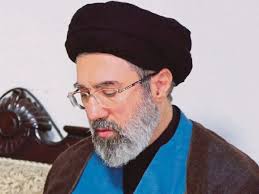
A cleric recognized by his salt-and-pepper beard and the black turban worn by descendants of the Prophet Muhammad, Mojtaba Khamenei is also a veteran of the Iran–Iraq War in the 1980s.
In 2019, during the presidency of Donald Trump, the United States imposed sanctions on him, claiming he acted on behalf of his father despite never holding a formal government position. At the time, the US Treasury alleged that Ali Khamenei had delegated parts of his leadership responsibilities to Mojtaba, who reportedly worked closely with Iranian security forces to advance his father’s regional and domestic policies.
Opposition groups have also accused Mojtaba of involvement in the violent suppression of protests following the controversial re-election of former president Mahmoud Ahmadinejad in 2009. The disputed vote sparked a massive protest movement across Iran.
Investigations by international media have also drawn attention to Mojtaba Khamenei’s alleged financial assets. According to reports citing intelligence sources, he is believed to have accumulated wealth exceeding $100 million through investments tied to oil revenues, including luxury real estate in the United Kingdom, hotels across Europe, and property in Dubai managed through offshore shell companies.
On the religious front, Mojtaba studied Islamic theology in the city of Qom, one of the most important centers of Shiite scholarship. There he also taught religious studies. Although he previously held the clerical rank of Hujjat al-Islam, he was elevated to the title of Ayatollah upon his appointment as Supreme Leader — the same rank held by his father and by Iran’s revolutionary founder Ruhollah Khomeini.
Personal tragedy also marked the transition of power. Iranian authorities say Mojtaba’s wife, Zahra Haddad-Adel, was among those killed in the airstrikes that also claimed the life of his father.
Meanwhile, Israel has issued a stern warning following the leadership change, stating that it will continue to pursue any successor to Iran’s leadership and those responsible for appointing them.
The Assembly of Experts, which consists of 88 clerics elected every eight years, has overseen only two leadership transitions in Iran’s modern history: the appointment of Ali Khamenei in 1989 after the death of Ruhollah Khomeini, and now the selection of Mojtaba Khamenei.