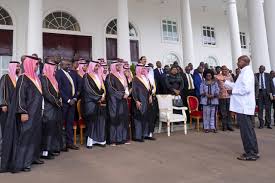
President Yoweri Museveni has hosted a high-level delegation from the Saudi Arabia at State House Entebbe, with discussions centred on boosting bilateral trade, value addition, and industrialization — particularly in Uganda’s coffee sector.
Investment-Led Cooperation
The Saudi delegation, led by Ali O Alswayeh, reaffirmed the Kingdom’s interest in expanding investments in Uganda, identifying agriculture and coffee value addition as priority areas.
Museveni welcomed the renewed engagement, noting that although Uganda and Saudi Arabia have maintained cordial relations for years, economic potential between the two nations remains underutilised.
“We have been working together for a long time, but we have not fully engaged to maximise our investment opportunities,” Museveni said.
Luwero Coffee Park at the Centre
A key highlight of the talks was the Value at Source Coffee Project (VASP) spearheaded by Nonda Coffee. The initiative aims to shift Uganda from exporting raw coffee beans to exporting branded, finished coffee products.
At the heart of this strategy is the proposed Luwero Coffee Park in Luwero District, projected to:
Process 42,000 metric tons of coffee annually
Generate USD 850 million in annual revenue
Create 1,500 direct jobs
Support 3,000 indirect jobs
Integrate over 100,000 coffee farming households into a structured supply chain
The industrial complex will handle the full value chain — cleaning, grading, roasting, grinding, specialty and soluble coffee production, packaging, branding, and export.
Strategic Middle East Market
Saudi Arabia is viewed as a gateway to the broader Middle East — one of the fastest-growing coffee consumption markets globally. Access to this market could significantly expand demand for premium Ugandan coffee while strengthening downstream opportunities for farmers.
Value Addition as National Strategy
Museveni has consistently emphasised value addition as a pillar of Uganda’s economic transformation agenda, arguing that exporting finished goods rather than raw materials increases export earnings, job creation, and industrial growth.
The meeting concluded with both sides committing to deepen cooperation in agro-processing, industrial development, and broader private-sector investment.
The engagement signals a strengthening of Uganda–Saudi Arabia economic relations, with coffee industrialization emerging as a central driver of future trade expansion.