Relatives of political prisoners in Venezuela have begun a hunger strike outside a prison in Caracas, demanding the release of all remaining detainees despite the recent freeing of 17 prisoners.
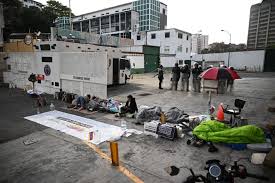
The protest began Saturday outside a national police facility known as Zone 7, operated by the Bolivarian National Police (PNB). About 10 women wearing face masks lay in a line at the prison entrance, with some spending the night on the ground.
“Sleeping eases the hunger,” one protester told AFP on condition of anonymity.
Pressure for Full Amnesty
Among the demonstrators was Evelin Quiaro, 46, whose son has been detained since November on terror-related charges. She said she stopped eating at around 1:00 am in solidarity with other families.
“The pressure has worked; we hope to stay here until everyone is released,” she said.
Earlier in the day, National Assembly President Jorge Rodriguez announced on social media that 17 prisoners had been freed, but did not provide names. He called on Venezuelans to “continue this path of peace for the construction of democratic coexistence.”
Amnesty Law Debate
The hunger strike comes as lawmakers debate a historic amnesty bill intended to pardon dissidents jailed under former leader Nicolas Maduro and his predecessor Hugo Chavez.
The reforms are being led by acting President Delcy Rodriguez, who assumed leadership following Maduro’s capture in a January 3 raid in Caracas.
The proposed legislation would cover charges such as treason, terrorism, and spreading hate — accusations frequently used against government critics. However, lawmakers postponed final approval of the bill after disagreements over whether beneficiaries should be required to appear in court to request amnesty.
Debate on the bill is expected to resume on February 19.
US Pressure and Political Transition
Rodriguez’s leadership transition reportedly received backing from US President Donald Trump, amid broader negotiations over Venezuela’s political future and oil exports.
Washington has also urged the Venezuelan government to release political prisoners as part of the post-Maduro transition.
According to the NGO Foro Penal, 431 political prisoners have been granted conditional release, while 644 remain behind bars.
As the political landscape shifts, thousands of opposition supporters have taken to the streets of Caracas, calling for the full implementation of the amnesty and the release of all detainees.
For families camped outside the prison gates, the message remains clear: the struggle will continue until every political prisoner is free.