What if the trunk of a banana plant — usually thrown away after harvest — could be turned into your T-shirt, a notebook, or even eco-friendly food packaging?
That idea is quickly becoming reality. Factories are now learning how to turn banana pseudostems (the thick trunk-like part of the plant) into a standardized raw material for textiles, paper, and bio-based packaging.
A Massive Untapped Resource
Only a small part of a banana plant becomes food. The rest is biomass that often stays in the field or is treated as waste. In some farming systems, banana residue can reach about 220 tons per hectare.
In major banana-producing countries like Brazil, pseudostems generate tens of millions of tons of agricultural waste every year. Instead of burning or dumping this material, companies are now seeing it as a valuable resource.
The reason is simple: banana pseudostems contain strong natural fibers made mostly of cellulose. Studies show that these fibers can have tensile strength of around 570 megapascals — stronger than many traditional natural fibers like jute and sisal. That makes them suitable for clothing, paper, and even composite materials.
From Craft Material to Industrial Supply Chain
In the past, banana fiber was mostly used in small craft projects. Today, the big change is industrialization.
Factories are organizing proper supply chains with quality standards, traceability, and safety systems similar to those used for cotton or other plant fibers. In Brazil, textile research centers such as the SENAI Institute of Textile Technology, Apparel and Design are helping move banana fiber production from small workshops to large-scale factories.
Projects like Banana Têxtil have already shown that fabric made from banana stems can be woven and used commercially, not just as a handmade novelty.
How Banana Fiber Is Made
Production usually begins near banana farms. Fresh pseudostems are heavy and full of water, so processing them close to the fields reduces transport costs and emissions.
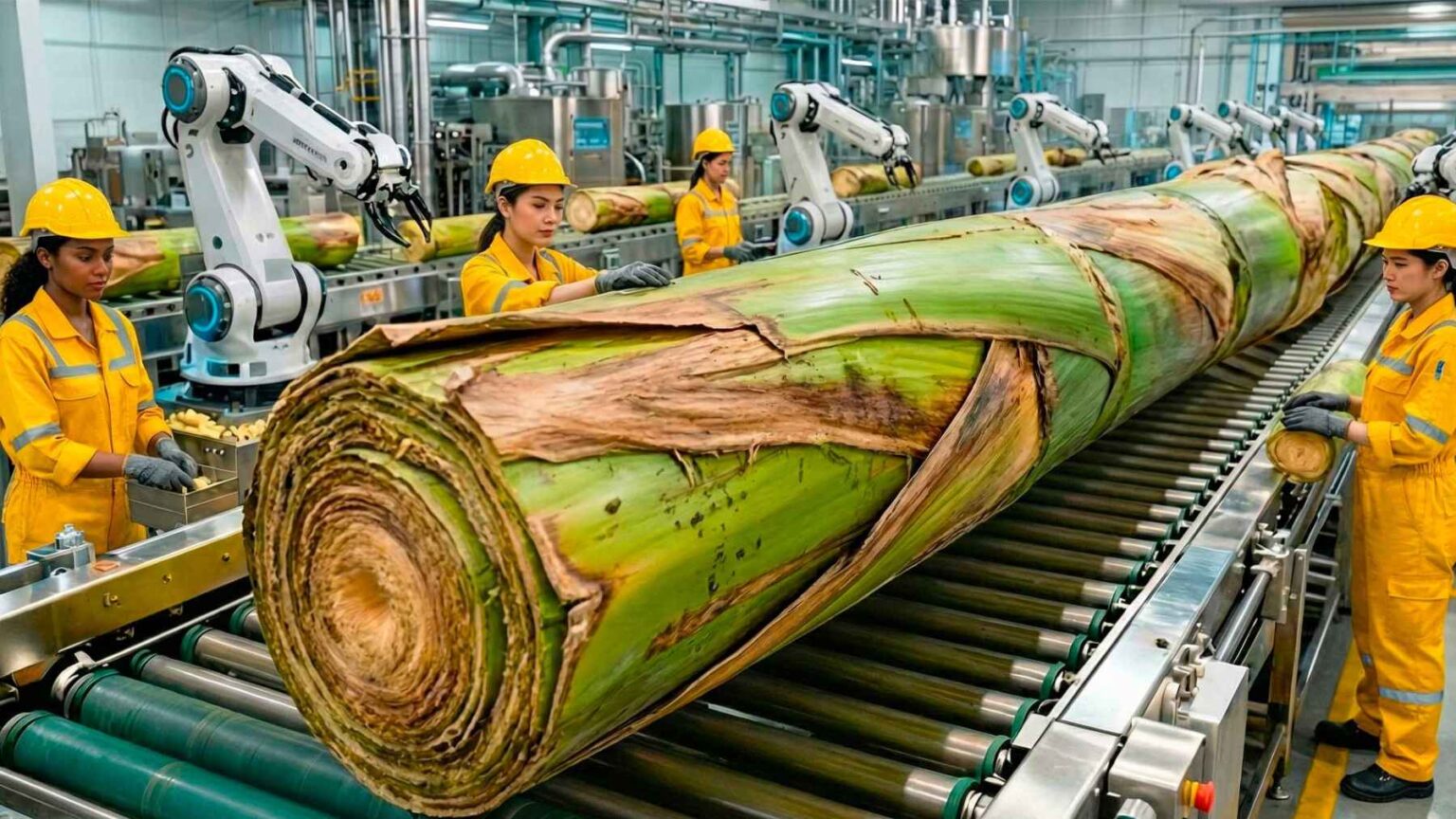
The main industrial process is called mechanical extraction or decortication. In this process:
Rollers and blades press and scrape the pseudostem.
The strong fibrous strands are separated from the soft pulp.
The fibers are collected for further treatment.
Mechanical extraction is preferred because it avoids harsh chemicals and is easier to scale up.
After extraction, the fibers are washed to remove impurities and odor. This step uses a significant amount of water, so modern plants invest in water recycling and wastewater treatment systems to reduce environmental impact.
Drying and Quality Control
Once cleaned, the fibers must be carefully dried. Factories use ventilated air systems and controlled-temperature ovens to prevent mold and maintain color.
Drying temperature affects fiber strength and durability, so it is treated as a controlled industrial step — not just sun-drying.
Quality teams then measure:
Fiber length
Moisture content
Purity
Mechanical strength
Consistency is key. Textile mills and paper manufacturers need banana fiber that performs the same way every time.
Beyond Clothing: Paper and Packaging
While textiles get most of the attention, banana fiber is also being tested in paper and packaging production.
Recent studies show that thermomechanically extracted banana fiber can be molded into fruit packaging trays. In some tests, these trays performed as well as or better than recycled paper pulp products in terms of strength — although they absorbed more water.
This opens opportunities for biodegradable food packaging made from agricultural waste.
What Happens to the Rest?
The fiber is only part of the plant. The leftover pulp and sap from extraction can be turned into:
Compost
Organic fertilizer
Biogas
Liquid biofertilizers
Some experiments show that banana pseudostem-based liquid fertilizers can help farmers reduce their dependence on synthetic chemicals.
For the industry to remain sustainable, nearly all parts of the biomass must be used. Otherwise, waste disposal and odor problems could harm local communities.
A Promising but Evolving Industry
Banana fiber will not replace all synthetic materials. There are still challenges in logistics, farmer training, water management, and production scaling.
However, the opportunity is clear. Instead of burning banana trunks after harvest, they can be transformed into valuable products that support a circular economy.
By turning agricultural waste into clothing, paper, and packaging, banana fiber could help reduce fossil fuel use and make industries more sustainable — all starting from something that was once simply left in the field.