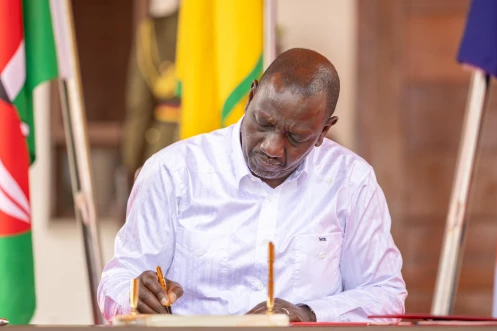
President William Ruto’s promise to allow all Grade 10 learners to report to school without fees is failing in practice, leaving hundreds of students locked out of classrooms and their dreams hanging in the balance.
Two weeks ago, President Ruto directed all learners who had not reported to Grade 10 because of financial difficulties to go to school immediately, even without fees, uniforms, bedding, or other requirements. He assured the country that the government would meet all the costs to ensure a 100 per cent transition under the Competency-Based Curriculum (CBC).
For many families, the directive came as a lifeline. Parents and learners believed that a presidential order carried the force of law. Armed only with admission letters and hope, they reported to schools across the country. What followed, however, was disappointment.
Several learners were turned away at school gates, with headteachers insisting that fees and essential items were still required. In informal settlements such as Mukuru kwa Reuben and Makadara in Nairobi, many Grade 10 learners remain at home despite having been admitted to national and extra-county schools.
Helen Maweu, who scored 50 marks and was admitted to Ngaru Girls, was sent back home with her parents after being told fees were mandatory. Ramsey Caros, another learner, has since abandoned school and taken up casual jobs after being denied admission. Similar stories have been reported from Makueni, Machakos, Murang’a, and other counties.
Fifteen-year-old Denis Mutuku, admitted to Mumbuni Boys High School after scoring 60 marks, still hopes the promise will be honoured. Others, like Regina Mulewa and Glen Mosoti, say their attempts to report to school were futile despite citing the President’s directive.
School heads, on their part, say they are caught in the middle. They argue that the government has not released additional funds to support learners who cannot pay fees. Without extra capitation, they say schools lack food, bedding, learning materials, and staff capacity to absorb more students.
Education officials have yet to issue clear guidelines or timelines on when the promised funding will reach schools. As a result, implementation of the directive has been left to individual institutions, creating confusion and inconsistency nationwide.
Kenya is currently transitioning the first CBC cohort into senior school (Grade 10), a critical phase meant to guarantee access and equity. However, without immediate government funding and clear instructions, the goal of 100 per cent transition risks remaining a policy statement rather than reality.
Parents and learners are now calling on the national government and the Ministry of Education to move beyond promises and release funds urgently. For many students, every passing day outside school increases the risk of dropping out permanently.
As classrooms remain out of reach, the question persists: who is responsible for turning presidential promises into action—and how long must vulnerable learners wait?