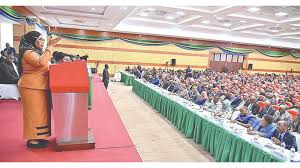
In just 100 days, President Samia Suluhu Hassan has accelerated a digital governance drive that is quietly but decisively reshaping how government officials work, communicate, and are held accountable. The message from State House has been unmistakable: in the digital age, there is no place to hide.
Through a rapid expansion of digital monitoring systems, online reporting tools, and public-facing government platforms, Samia’s administration is tightening oversight across ministries, departments, and agencies—reducing bureaucratic opacity that has long shielded inefficiency and inertia.
Digital tools as instruments of accountability
At the centre of the push is the growing use of real-time digital reporting, performance dashboards, and electronically tracked deliverables. Senior officials are increasingly required to submit updates, respond to directives, and account for delays through systems that leave permanent data trails.
Unlike paper-based bureaucracy, digital systems compress time and visibility. Missed deadlines, stalled projects, and conflicting reports are easier to detect, compare, and escalate—often without the need for physical inspections or lengthy internal correspondence.
For many officials, this has fundamentally altered how government work is done.
Ending bureaucratic invisibility
For decades, critics of public administration in Tanzania have pointed to a culture where responsibility was easily deflected and underperformance obscured by layers of procedure. Samia’s digital approach is designed to dismantle that culture by making performance measurable and visible.
Officials who previously operated beyond the public eye now find themselves exposed to internal audits, leadership scrutiny, and—in some cases—public feedback enabled by digital platforms.
According to governance analysts, this shift has reduced room for excuses while increasing pressure for responsiveness, particularly at senior levels of government.
Speed, access, and public trust
Beyond internal accountability, the digital blitz has also focused on improving citizen access to government services. Online portals, digitised records, and electronic communication channels are shortening service timelines and reducing reliance on physical offices—an important step in fighting corruption linked to discretionary, face-to-face processes.
By limiting human gatekeeping and standardising procedures, the government aims to restore public confidence in institutions that have often been criticised for inefficiency and opacity.
Resistance and growing pains
As with any reform, resistance has not been absent. Some officials have struggled to adapt to faster workflows and continuous monitoring, while others quietly express discomfort with systems that limit discretion and expose weaknesses.
Technical capacity gaps, uneven internet access, and the need for staff retraining remain challenges. However, the administration has signalled that digital reform is not optional but foundational to the country’s governance future.
A leadership signal
More than a technological upgrade, Samia’s 100-day digital push is being interpreted as a leadership statement—that governance will be judged by data, delivery, and transparency rather than rhetoric.
By embedding accountability into systems rather than personalities, the President appears intent on institutionalising reform beyond individual office holders.
As Tanzania continues its digital transformation, the early message is clear: government officials are no longer judged behind closed doors. In a system increasingly defined by screens, dashboards, and digital footprints, performance—or the lack of it—is now impossible to conceal.