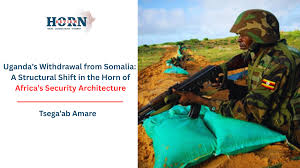
Uganda’s decision to fully withdraw its troops from Somalia marks the end of a two-decade security era and represents a fundamental restructuring of the Horn of Africa’s security architecture. The announcement, made on January 26, 2026, by Uganda’s Chief of Defence Forces, General Muhoozi Kainerugaba, signals not a tactical redeployment but a strategic disengagement with far-reaching regional consequences.
Since 2007, Uganda has been the cornerstone of the African Union’s military presence in Somalia. It pioneered the African Union Mission in Somalia (AMISOM) and later became a foundational contributor to its successor, the African Union Support and Stabilization Mission in Somalia (AUSSOM). Throughout periods of intense instability, Ugandan forces played a decisive role in securing Mogadishu’s critical infrastructure and preserving the operational continuity of Somalia’s federal government.
An Unconventional Announcement with Immediate Consequences
The manner of the withdrawal announcement reflects the increasingly personalized nature of Uganda’s military diplomacy. General Kainerugaba declared on the social media platform X that Uganda would “completely withdraw” its forces from Somalia in the near term, effectively signaling the end of the mission. The announcement bypassed conventional diplomatic and multilateral channels, injecting uncertainty into an already fragile security environment.
This declaration aligns with long-standing frustrations expressed by President Yoweri Museveni, who has repeatedly criticized Somali political infighting and the lack of durable political reconciliation. However, the timing and method of the announcement have amplified its destabilizing effect.
Uganda’s Central Role in Somalia’s Security
For nearly nineteen years, Uganda functioned as the mission’s operational backbone and shock absorber. When other troop-contributing countries hesitated to operate in high-risk urban environments, Ugandan forces led offensive operations that culminated in Al-Shabaab’s removal from Mogadishu in 2011.
The Uganda People’s Defence Forces (UPDF) controlled some of the mission’s most demanding sectors, including Lower Shabelle, Aden Adde International Airport, the Port of Mogadishu, and Villa Somalia. This sustained commitment came at a high human cost. Of the estimated 4,000 peacekeeper casualties since 2007, Uganda—alongside Burundi—has borne the largest share.
Uganda’s withdrawal therefore removes not only manpower, but also the mission’s logistical coherence, institutional memory, and psychological deterrence against insurgent resurgence.
A Triple Crisis Triggered by Uganda’s Exit
1. Somalia: Erosion of Capital Security
For Somalia, Uganda’s departure poses a direct threat to the federal security architecture. Ugandan forces have been the primary guarantors of stability in Mogadishu. Their exit risks renewed pressure on the capital from Al-Shabaab, which has already intensified operations in Middle and Lower Shabelle.
Although the Somali National Army has made progress, it remains fragmented, with just over 20,000 reliably deployable troops. These forces continue to depend heavily on external logistics, intelligence, and air support. In the absence of Ugandan rapid-response units and counter-IED expertise, Mogadishu may increasingly rely on Ma’awisley clan militias.
While effective in short-term localized defense, such militias are prone to decentralization and warlordism—dynamics that Al-Shabaab has historically exploited through clan mediation and infiltration.
2. Egypt: A Geopolitical Inflection Point
Uganda’s withdrawal significantly increases the likelihood of a full activation of Egypt’s security agreement with Somalia. Existing arrangements between Cairo and Mogadishu allow for the potential deployment of up to 10,000 Egyptian personnel through a mix of AUSSOM allocations and bilateral frameworks.
A large-scale Egyptian deployment would represent the most geopolitically consequential outcome of Uganda’s exit. It risks transforming Somalia from a counter-insurgency theater into an arena of interstate competition, particularly over Nile Basin politics and the Grand Ethiopian Renaissance Dam (GERD).
By positioning special forces in central provinces and border regions, Egypt would seek to constrain Ethiopia’s regional maneuverability, further militarizing Somalia’s internal security environment and deepening proxy dynamics.
3. Ethiopia: Heightened Border Vulnerability
For Ethiopia, Uganda’s withdrawal removes a key stabilizing buffer along its eastern and southeastern corridors. This exposure is compounded by the politically driven reduction of Ethiopia’s troop quota under AUSSOM to approximately 2,500 personnel, following Addis Ababa’s diplomatic engagement with Somaliland.
Ethiopia now faces a strategic dilemma: either undertake a costly unilateral surge to secure its borders—risking Somali nationalist backlash and operational overstretch—or accept a degraded security environment in which Al-Shabaab can project force into Ethiopia’s Somali Regional State.
Further risks stem from Mogadishu’s previous efforts to redeploy Ethiopian contingents away from border zones into central Somalia, stripping them of established intelligence networks and increasing vulnerability to insurgent ambushes.
Structural Drivers Behind Uganda’s Withdrawal
Uganda’s decision is shaped by three interlocking structural pressures.
First, AUSSOM is facing a severe funding crisis. The mission requires approximately $196 million for 2025, yet pledged contributions amount to less than $50 million. Reductions in logistical support through UNSOS have further strained operations. Uganda’s withdrawal exposes a deeper institutional rupture, raising questions about the African Union’s ability to sustain long-term peace enforcement without predictable and autonomous financing.
Second, following the January 15, 2026 general elections, which President Museveni won amid an internet shutdown, Kampala is prioritizing domestic consolidation. The return of battle-hardened troops provides additional security capacity to manage post-electoral tensions and address instability along Uganda’s border with the Democratic Republic of Congo.
Third, prolonged strategic stagnation has eroded political commitment to the Somalia mission. After nearly two decades, Ugandan leadership increasingly views the operation as lacking a viable political endgame. Kampala is not exiting from victory, but from a mission perceived as politically stalled and strategically unrewarding.
Conclusion: A Fragmenting Security Landscape
Uganda’s planned withdrawal constitutes a decisive structural inflection point in the Horn of Africa’s security order. Immediate risks include the erosion of Mogadishu’s security, the decentralization of armed force, and a potential resurgence of Al-Shabaab. Regionally, the move externalizes risk toward Somalia’s neighbors—particularly Ethiopia—and accelerates a shift toward interest-driven, bilateral security arrangements.
Absent predictable international financing and meaningful political reconciliation within Somalia, the vacuum left by Uganda is unlikely to remain empty. Instead, it risks being filled by insurgent resurgence, intensified proxy competition, and further fragmentation of regional security.
The Somalia mission is no longer evolving as a multilateral peace operation anchored in collective legitimacy. It is increasingly becoming a security marketplace, shaped by bilateral power politics and competing regional ambitions.