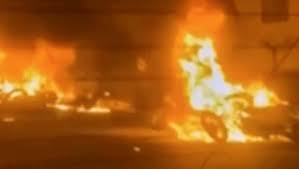
Iran was largely cut off from the outside world on Friday after authorities shut down internet access in an effort to contain widening anti-government unrest, as videos circulating online showed buildings and vehicles set ablaze in several cities.
According to rights groups, dozens of protesters have been killed during nearly two weeks of unrest, while Iran’s semi-official Tasnim news agency reported that several police officers were also killed overnight. Iranian state television aired footage of clashes between protesters and security forces, alongside scenes of fires and vandalism.
In a televised address, Supreme Leader Ayatollah Ali Khamenei vowed that the Islamic Republic would not retreat in the face of the unrest. He accused demonstrators of acting on behalf of exiled opposition groups and the United States, warning that the state would respond decisively. Tehran’s public prosecutor reinforced the message, threatening death sentences for those accused of sabotage, arson or violent clashes with security forces.
The protests, which began late last month, were initially driven by economic grievances. Iran’s currency, the rial, lost about half its value against the U.S. dollar last year, while inflation surpassed 40 percent in December, placing severe pressure on household incomes. Over time, demonstrations have evolved from economic demands to direct political slogans targeting the country’s leadership.
While the current unrest has not mobilised as broad a cross-section of society as some previous protest movements, analysts say authorities appear more vulnerable due to the country’s deepening economic crisis and the lingering effects of last year’s war with Israel and the United States.
The nationwide internet blackout significantly reduced the flow of information from Iran. Phone calls into the country were reportedly not going through, and Dubai Airport confirmed that at least 17 flights between Dubai and Iranian cities had been cancelled.
State television broadcast images of burning buses, cars and motorbikes, as well as fires at metro stations and banks, blaming the violence on the People’s Mujahedin Organisation (MKO), an exiled opposition group that split from Iran’s revolutionary movement after 1979.
In Rasht, a port city on the Caspian Sea, a state TV journalist described the situation as resembling a “war zone,” saying shops along Shariati Street had been destroyed. Videos verified by Reuters from Tehran showed hundreds of people marching through the streets, with some chanting “Death to Khamenei!” and others expressing support for the former monarchy.
Iranian Kurdish rights group Hengaw reported that a protest march following Friday prayers in Zahedan, a city with a large Baluch minority population, was met with gunfire that wounded several people.
Authorities have so far pursued a dual strategy—acknowledging that economic protests are legitimate while condemning what they describe as violent rioters. Last week, President Masoud Pezeshkian urged officials to adopt a “kind and responsible approach” and announced modest financial relief measures to address rising poverty. However, as unrest intensified, senior leaders adopted a much harsher tone.
“The Islamic Republic came to power through the blood of hundreds of thousands of honourable people. It will not back down in the face of vandals,” Khamenei said, accusing protesters of seeking to please U.S. President Donald Trump.
Iran’s fragmented opposition groups abroad have called for continued protests. Demonstrators have chanted slogans such as “Death to the dictator!” while some voiced support for the monarchy overthrown in the 1979 revolution. Reza Pahlavi, the exiled son of the late shah, urged Iranians on social media to take to the streets, saying the world was watching.
The level of support inside Iran for exiled opposition groups remains disputed. A spokesperson for the MKO claimed the group’s supporters were involved in the demonstrations. Trump, who authorised U.S. strikes on Iran last summer, said he would not meet Pahlavi and was unsure whether supporting him would be appropriate.
Despite rising tensions, Iranian Foreign Minister Abbas Araqchi said the likelihood of foreign military intervention was “very low,” adding that Oman’s foreign minister—whose country often mediates between Iran and Western powers—was expected to visit Tehran.
U.N. High Commissioner for Human Rights Volker Türk said he was “deeply disturbed” by reports of violence and by the shutdown of communications.
Iran has experienced several waves of nationwide unrest since the 1979 revolution, including student protests in 1999, mass demonstrations after disputed elections in 2009, protests over fuel prices and economic hardship in 2019, and the Woman, Life, Freedom movement in 2022. While previous protests were eventually suppressed, they have at times forced limited social and political concessions, underscoring the persistent tensions between the state and segments of Iranian society.