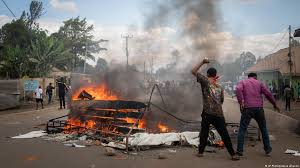
A Reuters investigation has revealed disturbing accounts of civilians killed during violent unrest that followed Tanzania’s general elections held on October 29, 2025, with witnesses and human rights figures alleging that security forces deliberately targeted unarmed people far from protest sites.
One of the deadliest incidents occurred on the evening of October 31 in the Mjimwema neighbourhood of Mwanza, Tanzania’s second-largest city. According to multiple eyewitnesses interviewed by Reuters, police officers opened fire without warning on residents who were going about their daily activities, including shopping and sitting in roadside cafés.
Witnesses said officers ordered men sheltering inside a café to lie on the ground before shooting at them. When the gunfire stopped, more than a dozen people were dead. A video posted on social media in early November and later verified by Reuters showed at least 13 bodies lying in pools of blood near the café.
The Mjimwema killings, reported in detail for the first time, were among the most lethal incidents in days of unrest sparked by the disqualification of two leading opposition candidates ahead of the presidential vote. Reuters said the violence marked the worst political unrest in Tanzania since independence.
Reuters interviewed nine witnesses to eight separate incidents in Mwanza, Dar es Salaam and Arusha who said police fired on civilians who were not participating in protests, sometimes kilometres away from any demonstrations. Witnesses described officers shooting indiscriminately or targeting people accused of ignoring orders to return home, although Reuters could not establish the legal basis for such orders.
The unrest followed mass arrests and alleged abductions of government critics, undermining Tanzania’s long-standing reputation for political stability. The United Nations human rights office estimates that hundreds of people were killed during the violence, while independent experts appointed by the UN Human Rights Council have cited figures of at least 700 extrajudicial killings, with other estimates running into the thousands.
The protests were largely driven by young people demanding more accountable governance, echoing recent youth-led demonstrations in countries such as Kenya, Madagascar and Nepal.
Charles Kitima, secretary-general of the Tanzania Episcopal Conference, said the pattern of killings pointed to deliberate targeting of civilians.
“We have witnessed lots of people killed in their houses. That’s why we say it was intended killings,” Kitima told Reuters, while acknowledging that some looting did occur during the unrest.
President Samia Suluhu Hassan was declared winner of the presidential election with nearly 98 percent of the vote. In public statements, she has defended the security response as a necessary reaction to violence by protesters. Hassan, who assumed office in 2021 following the death of her predecessor, had initially pursued political reforms but has since tightened restrictions on opposition groups accused by her government of attempting to destabilise the country.
Following election-day protests in several cities, authorities shut down internet access nationwide for more than five days, limiting the flow of information. Before services were restored, police warned of legal action against anyone sharing images deemed to cause panic or harm personal dignity.
In December, UN-appointed experts said they had received “disturbing reports” suggesting security forces were issued “shoot-to-kill” orders during curfews, though they did not disclose their sources. The Tanzanian government has strongly denied this claim.
Palamagamba Kabudi, Minister of State in the President’s Office, said the government takes allegations of excessive force seriously and has established a commission of inquiry to investigate election-related violence. However, he said many claims were based on unverified or out-of-context information.
“The Government does not recognise a policy or practice of intentional brutality against civilians,” Kabudi said, adding that security operations are governed by legal safeguards.
Kabudi acknowledged that lives were lost but said it was too early to provide a definitive death toll, noting that the commission’s findings would be released “in due course.”
In Mjimwema, witnesses said police later collected bodies and drove them away in a large vehicle. Hospital sources told Reuters that about 15 young men with gunshot wounds were brought to Sekou Toure Hospital that night, most of them already dead.
Reuters confirmed the identities of three victims, including 39-year-old tailor Raphael Esau Magige and his 27-year-old nephew Johnson Patrick Deus, who had gone to the café to watch television news. Neither was politically active, family members said. Another victim was identified as 20-year-old domestic worker Juma Shaban Joseph, whose body has not been found, according to relatives.
The UN Human Rights Office said it had received reports suggesting bodies were taken to undisclosed locations, possibly to conceal evidence—an allegation the government denies.
By mid-December, the café at the centre of the Mjimwema killings had been dismantled, according to photographs seen by Reuters. It remains unclear who ordered its removal.
The events have intensified international scrutiny of Tanzania’s human rights record, with the United States saying it is reviewing its relationship with the country in light of the violence surrounding the election.