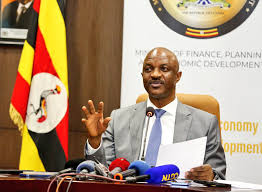
The Uganda Shilling has been ranked the most stable currency in the world, outperforming major global currencies such as the UK Pound Sterling and the Hong Kong dollar, according to the Permanent Secretary and Secretary to the Treasury, Ramathan Ggoobi.
Ggoobi made the remarks during the Quarter Three Press Briefing for the Financial Year 2025/26 held in Kampala, where he highlighted the Shilling’s resilience against the US dollar and other major international currencies.
He revealed that the local currency appreciated by 2.45 percent in the year ending December 2025.
“Currently, the Uganda Shilling is the most stable currency in the world, followed by the UK Pound Sterling and the Hong Kong dollar,” Ggoobi said.
Economists view currency stability as a key indicator of economic confidence, as it reduces uncertainty for businesses and investors, supports trade, and strengthens governments’ ability to manage economic cycles. Countries with stable currencies are also better positioned to withstand global economic shocks.
Ggoobi noted that Uganda’s economy has remained strong despite global uncertainties and the pressures typically associated with an election year.
He reported that the economy grew by 6.3 percent in the Financial Year 2024/25 and is projected to grow between 6.5 and 7 percent in the current financial year, with double-digit growth expected in the medium term.
As a result, Uganda’s economy is projected to reach $68.4 billion (Shs249.4 trillion) in the Financial Year 2025/26.
Inflation has also remained low, with headline inflation standing at 3.1 percent in both November and December 2025, a trend Ggoobi described as unusual during an election period.
He attributed this stability to deliberate government interventions, including increased investment in food production, effective monetary policy, and direct fuel importation by the Uganda National Oil Company (UNOC).
“This stability is a result of strategic government investments in food production, effective monetary policy which has kept the Shilling strong, and direct fuel importation by UNOC,” he said.
Ggoobi added that Uganda recorded the lowest inflation rate in Africa over the past decade, reinforcing the country’s macroeconomic stability.
On the external sector, he said export earnings continued to grow strongly, with exports of goods and services reaching $13.4 billion (Shs48.2 trillion) in the Financial Year 2024/25. Merchandise exports accounted for $10.6 billion (Shs38.2 trillion).
For the 12 months ending November 2025, exports of goods alone stood at $12.79 billion (Shs46.0 trillion).
Uganda also recorded a Balance of Payments surplus of $2.37 billion (Shs8.5 trillion) for the year ending October 2025, reversing a $683 million deficit recorded the previous year.
“This is the highest Balance of Payments surplus recorded in the last 15 years,” Ggoobi said, attributing it to an all-time high financial account surplus of $5.6 billion (Shs20.2 trillion).
Foreign direct investment rose to $3.5 billion (Shs12.6 trillion), while portfolio inflows reached $1.7 billion (Shs6.1 trillion).
He also highlighted the growing contribution of the Ugandan diaspora, noting that remittance inflows increased to $1.6 billion (Shs5.76 trillion) in the Financial Year 2024/25, up from $1.1 billion in 2020/21.
Ggoobi said the strong performance of the Shilling and broader macroeconomic indicators demonstrated the resilience of Uganda’s economic fundamentals and the critical role of currency stability in supporting growth, investment, and economic confidence.