The United States carried out airstrikes on Christmas Day against suspected Islamic State (IS) militants in northwestern Nigeria, marking the first US military action in the country under President Donald Trump and intensifying already sensitive diplomatic and security dynamics.
President Trump said on Thursday that US forces had conducted what he described as “powerful and deadly” strikes against IS-linked militants, weeks after he publicly warned that Washington would respond forcefully to what he characterised as systematic killings of Christians in Nigeria.
Nigeria’s Ministry of Foreign Affairs confirmed the strikes early Friday, describing them as “precision hits on terrorist targets” carried out in coordination with Nigerian authorities. The US Department of Defense’s Africa Command (AFRICOM) said the operation took place in Sokoto State and resulted in the deaths of “multiple ISIS terrorists,” using the acronym for the Islamic State group. The strikes were reportedly conducted at Nigeria’s request.
Neither the US nor Nigerian authorities provided specific details on the number of casualties or the exact locations targeted.
In a series of posts on his Truth Social platform, Trump linked the strikes directly to his administration’s stance on the protection of Christians worldwide. “I previously warned these Terrorists that if they did not stop the slaughtering of Christians, there would be hell to pay, and tonight, there was,” he wrote. He added: “MERRY CHRISTMAS to all, including the dead Terrorists, of which there will be many more if their slaughter of Christians continues.”
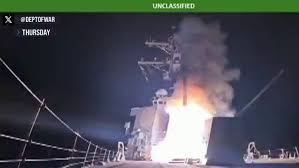
US defence officials later released footage appearing to show the nighttime launch of a missile from a US-flagged battleship, though further operational details were not disclosed.
The strikes come after Trump sharply criticised Nigeria in October and November, claiming Christians in the country faced an “existential threat” amounting to “genocide.” His remarks drew mixed reactions, with some welcoming increased international attention, while others warned the rhetoric risked inflaming religious tensions in Africa’s most populous nation.
Nigeria’s government and independent analysts have repeatedly rejected framing the country’s insecurity as religious persecution, arguing instead that Nigeria faces complex and overlapping security challenges that affect both Christian and Muslim civilians.
Nonetheless, Trump has increasingly spotlighted what his administration describes as global persecution of Christians and warned last month that the United States was prepared to take military action in Nigeria if such killings continued.
In a statement, Nigeria’s foreign ministry emphasised ongoing cooperation with international partners. “Nigerian authorities remain engaged in structured security cooperation with international partners, including the United States of America, in addressing the persistent threat of terrorism and violent extremism,” the ministry said.
US Defense Secretary Pete Hegseth echoed this sentiment, saying he was “grateful for Nigerian government support and cooperation” in a post on X.
Earlier this year, Washington placed Nigeria back on its list of countries of “particular concern” for religious freedom and imposed visa restrictions on Nigerians. Trump also threatened to cut all US aid to Abuja if it “continues to allow the killing of Christians.”
Nigeria is almost evenly split between a largely Muslim north and a predominantly Christian south. Its northeast has endured more than 15 years of jihadist violence by Boko Haram and its splinter groups, a conflict that has killed over 40,000 people and displaced more than two million.
At the same time, vast areas of the northwest, north-central and central regions are plagued by heavily armed criminal gangs known locally as “bandits,” who regularly raid villages, abduct residents for ransom and kill civilians.
The Christmas Day strikes came against this backdrop of widespread insecurity. On Wednesday, an explosion tore through a mosque in Maiduguri, the capital of Borno State in northeastern Nigeria, killing at least seven worshippers. No group immediately claimed responsibility.
As investigations continue, the US strikes are likely to fuel further debate over foreign military involvement in Nigeria’s security challenges and the broader implications for regional stability and religious relations.